The HC school board is currently considering a proposal to pilot a foreign language program at the elementary school level. The idea is to integrate the use of computer technology into regular classroom instruction and eliminate the hour-long segment that they spend each week in a separate computer lab. (I guess they would still potentially use the lab space, but it would be with their homeroom teacher, and it would relate directly to whatever they're working on in class anyway.) This would free up two half-hour time slots each week for language instruction, which would be undertaken according to a content-based approach. The language instructor would work with the students on content they're expected to learn anyway--science, social studies, etc.--but conduct the class in a high percentage of the foreign language, so they get exposed to its various elements. Obviously, the emphasis would be on vocabulary and situational dialog; there would be little technical discussion of the grammar and structure of the language. The proposal is to teach all students in all schools Mandarin Chinese, but they estimate that they could offer two language options for about 10% more cost.
I have no objection to them studying a foreign language, and I'm reasonably sure the integrated approach to technology could work, though I'm not at all certain that it will. I guess my main question relates to the language selection. Now, I'll readily admit that as someone who has studied several different languages, I'm probably biased by not being personally interested in Chinese. I understand why it was chosen--the number of people in the world who speak the language, the role of China in the world economy, and the length of time and effort required to achieve some level of fluency (which makes it more beneficial to get an early start)--but I still think an argument can be made against it.
It's certainly sensible to learn the language of our new overlords. China produces the goods we buy, and loans us the money to buy them. When our politicians bicker us into default, it is China that will be first in line to repossess our country. History is filled with examples of major powers whose languages became the common currency of trade and government--Akkadian, Aramaic, Greek, Latin, etc. English is one of the more recent examples, but we're probably not far from the time when the sun really will set on the British/American Empire. China is a logical choice for the next big thing.
But I wonder if it isn't morally superior to change tactic, especially if we're not quite ready to admit defeat on the world stage, and instead reach out to those who live within our borders in ever-increasing numbers and will likely surpass English-speakers in the overall population. I'm talking about the Hispanic population, with whom we share this half of the world, and many of whom have one way or another made their way to the United States. Learning the language of those who are powerful, because we must, is one thing; but learning the language of those who are not, because we can, is something altogether different.
I also wonder if we aren't missing an important aspect of language learning. It used to be standard to learn Latin, not so much because of all the Latin-speakers out there with whom we could converse, but because of what it teaches us about our own language. I'm not so naive as to think that we'd return to that any time soon, but doesn't this other purpose of learning a foreign language apply to some degree when we learn any other language? It helps us to think about similarities and differences, and with good instruction, we can understand how those connections arise. But the further two languages are removed from one another, the harder it can be to find informative connections. Especially when we're talking about language taught at the elementary school level, they probably won't draw many conclusions about grammatical structure by experiencing two languages. But cognate words are much easier to discover and can be very useful in building vocabulary in one's own native language. It seems to me that students would gain more insight about English by learning one of its closer relatives.
The point about needing more time to learn Chinese was one I didn't think of until it was specifically brought up in discussion. There is a great deal of sense to it, but I wonder how realistic it is. A lot of the point of how this program is designed is to make it something that will work for all students. But do we seriously think that all, or even most, students will continue their study of Chinese once they have other options? And don't the same factors that make it a longer enterprise to learn Chinese also make it that much easier to lose in a summer what they've learned during the school year? How much benefit will they retain over time?
Consider writing, for instance. I don't know if there is any intention to teach Chinese writing--I would assume there would be, but maybe it's considered too complex to bother with. Either way--if they don't cover writing, students have missed an area of learning; if they do, the struggle will be long and hard, and most of them will probably forget everything they ever learned. On the other hand, a language like Arabic would also take substantial time to learn, would have quite a bit of relevance in today's world, and would challenge students with its writing system. But here, "challenging" does not mean "inaccessible." Arabic writing is difficult, but it is still an alphabetic system (technically, it's an abjad, but I'm trying not to be technical) and therefore involves a relatively small set of characters. Even if some information is lost over the summer, the task of reviewing and re-learning at the beginning of the next year is much smaller. But if we're talking about a language program for all students, it's probably better to go with something that uses the same basic Latin characters students are already familiar with.
I also like the argument that teaching English-speaking students Spanish will help them interact with their fellow students whose first language is Spanish. If it is true that Spanish-speakers typically have more difficulty adjusting to American schools than other immigrant groups, anything we can do to help bridge this gap and make the transition easier will likely save the schools money they might otherwise spend on special assistance programs.
For these reasons, I think Spanish is the better way to go. I say this as someone who has never formally studied Spanish, who doesn't speak Spanish, and who has no Hispanic heritage. But if we're going to teach one foreign language in all elementary schools, I think Spanish wins as the most useful and attainable option.
Saturday, May 28, 2011

Thursday, May 19, 2011
in defense of polygamy
We've been paying for TV for a couple of years now. It has its advantages, I suppose. There are more options for the kids, not many of which are worth having. (My own recollection of a childhood without pay TV is that I mostly watched prime-time programming--the Muppet Show, of course, but action and sci-fi shows like A-Team, Airwolf, and Automan come to mind.) We decided to pay extra for DVR, which has the distinct benefit of eliminating commercials from much of our viewing. Mostly the broader selection seems to have had the negative effect of niche viewing. Where before Julie and I used to spend time after the kids went to bed watching sit-coms and a few action dramas like Alias and Lost, now she has a long list of TLC-type programming and I have local government TV. I can only take so much of little people and hoarders and coupon clippers, and my tolerance for shows about wedding dresses and giving birth is almost non-existent. She groans in what I assume is agony, if she happens to walk through the room and catch 15 seconds of a school board meeting.
One of the few shows that we have managed to watch together is Sister Wives. I guess it meets all the usual requirements of standard TLC fare--prying into someone else's family life, border-line freak show, abnormal numbers of kids, and the tired format of reality TV, where even the most mundane moments are supposed to generate suspense and tension. I'm mostly interested in the phenomenon of polygamy--interested enough, I guess, that I can put up with the rest of it.
I should say, I'm not a polygamist in reality or in principle. Personally, I can't imagine how or why anyone would want to have more than one wife. Sustaining one such relationship takes enough energy, and as I've told Julie, I don't even envision myself remarrying if something ever happened to her. I also don't think polygamy was ever God's intent for human relationships; but the fact is, he did allow it. And that, I think, is significant.
From Mesopotamian law, we get a picture of polygamy for expedience. The motivation seems to be mostly childbearing. If a first wife couldn't produce, a second wife might be taken. Laws were provided to protect the rights of the first wife, since the wife with children might otherwise supplant her as more valuable. This same pattern plays out in the Bible, with Sarah and Hagar and later with Leah and Rachel. The only other kind of polygamy we see is when Israel's kings start taking multiple wives for political reasons. Both types seem to produce negative side-effects--internal family strife, religious compromise, and even tribal warfare. But they are tolerated within limits, as is divorce, probably to prevent the kind of actions people might have taken without that allowance. (Think, Henry VIII . . . )
What's harder for me to understand is polygamy that seems to be valued for its own sake. I've heard--though I'm no authority on the subject--that Mormon doctrine teaches salvation for the man as head of a household, where his wives' salvation depends on their relationship to him. I suppose, if that is widely known and accepted, it could be a motivation to extend salvation through marriage. But is that really a doctrinal difference between mainstream Mormons and the polygamist type? Or is it simply that polygamy became a cultural norm within Mormonism, and some conservatives turned it into a religious conviction, mostly because their church betrayed that practice? The reason for polygamy never really seems to be addressed in the show--it's presented as a lifestyle choice, often based on upbringing, but otherwise without much explanation.
But I think it's this presentation as a lifestyle choice that holds my attention. In a culture where we've come to accept extramarital sex, cohabitation, divorce and remarriage, homosexuality, and even same-sex marriage as more or less a matter of personal choice, why do we look at polygamy as just some obscure freak-show fodder? As a Christian, I look at the options out there, and I see polygamy as a whole lot more defensible than most of them. I'm sure there are abuses, and I would guess that making it illegal skews the numbers of those willing to make that choice toward the lunatic fringe. But the family in the show seems reasonably healthy--arguably, a good deal more healthy than so many half-families and re-mixed families resulting from divorce. The women chose this relationship as adults. The kids seem to interact well together. They seem to be getting by financially. I'm not even sure how they can be prosecuted, since he's only married legally to one of the four wives; but in any case it seems like an archaic legal stance to consider this criminal activity, while a man sleeping with multiple women but married to none of them would be considered safe, legal, and normal.
Is it that we just haven't had enough activism directed at recognizing polygamy as a lifestyle choice? Is it that we're culturally biased to accept choices that destroy family more easily than those that promote it? I don't know, but I can't escape the feeling that this is something worth defending. I wouldn't want to be polygamist, I wouldn't advise polygamy. But if we're destined to have a culture of choice, how can we possibly rule it out as an unacceptable option? And maybe, just maybe, having polygamy as a viable option on one end of the spectrum would help to create a more balanced perspective on traditional family.
Monday, May 2, 2011
from the Akathist for the Repose of Those Who Have Fallen Asleep
I'm no friend of Osama bin Ladin, and I'm not about to dispute whether he deserved to die. Still, as Gandalf told Frodo, "Many that live deserve death. And some that die deserve life." If we can't give the latter, we shouldn't be too quick to cry for the former either.
The verse from Proverbs that you often hear quoted is interesting:
But for Christians, the standard is Jesus, is it not? He who rebuked his disciples for wanting to call down fire from heaven. He who forgave his enemies while they were putting him to death. He who told us to love and pray for our enemies. I know it's not an easy standard, but what good would it be if it were? This is one of the things I love about liturgical prayer. There's no rule that says we must pray in the words of the Church, though we are certainly supposed to pray with her heart. When we don't know how to do that, we have a wealth of model language to help us. Here, then, are a few pertinent sections from the Akathist for the Repose of Those Who Have Fallen Asleep:
Kontakion 2
Enlightened by the illumination of the Most High, Saint Macarius heard a voice from a pagan skull: "When you pray for those suffering in Hell, there is relief for the heathen." O wonderful power of Christian prayer, by which even the infernal regions are illumined! Both believers and unbelievers receive comfort when we cry for the whole world: ALLELUIA.
Ikos 3
O Glad Light, Redeemer of the world, embracing the whole universe with Thy love: behold, Thy cry from the Cross for Thine enemies is heard: "Father, forgive them." In the name of Thine all-forgiving love we make bold to pray to our Heavenly Father for the eternal repose of Thine enemies and ours.
Forgive, O Lord,
those who have shed innocent blood,
those who have sown our path of life with sorrows,
those who have waded to prosperity through the tears of their neighbors.
Condemn not, O Lord,
those who persecute us with slander and malice.
Repay with mercy those whom we have wronged or offended through ignorance,
and grant that our prayer for them may be holy through the sacrament of reconciliation.
O Lord of unutterable Love, remember Thy servants who have fallen asleep.
Kontakion 5
Thou hast given us death as a last prodigy to bring us to our senses and to repentance, O Lord. In its threatening light, earthly vanity is exposed, carnal passions and sufferings become subdued, insubmissive reason is humbled. Eternal justice and righteousness opens to our gaze, and then the godless and those burdened with sins confess on their deathbed Thy real and eternal existence and cry to Thy mercy: ALLELUIA.
Ikos 5
O Father of all consolation and comfort, Thou brightenest with the sun, delightest with fruits, and gladdenest with the beauty of the world both Thy friends and enemies.
And we believe that even beyond the grave Thy loving kindness,
which is merciful even to all rejected sinners, does not fail.
We grieve for hardened and wicked blasphemers of Thy Holiness.
May Thy saving and gracious will be over them.
Forgive, O Lord,
those who have died without repentance.
Save those who have committed suicide in the darkness of their mind,
that the flame of their sinfulness may be extinguished in the ocean of Thy grace.
O Lord of unutterable Love, remember Thy servants who have fallen asleep.
Kontakion 6
Terrible is the darkness of a soul separated from God, the torments of conscience, the gnashing of teeth, the unquenchable fire and the undying worm. I tremble at the thought of such a fate, and I pray for those suffering in Hell as for myself. May our song descend upon them as refreshing dew as we sing: ALLELUIA.
Ikos 6
Thy light, O Christ our God, has shone upon those sitting in the darkness and shadow of death and those in Hell who cannot cry to Thee. Descend into the infernal regions of the earth, O Lord, and bring out into the joy of grace Thy children who have been separated from Thee by sin but who have not rejected Thee.
For they suffer cruelly. Have mercy on them.
For they sinned against Heaven and before Thee,
and their sins are infinitely grievous,
and Thy mercy is infinite.
Visit the bitter misery of souls separated from Thee.
Have mercy, O Lord, on those who hated the truth out of ignorance.
May Thy love be to them not a consuming fire
but the coolness of Paradise:
O Lord of unutterable Love, remember Thy servants who have fallen asleep.
The verse from Proverbs that you often hear quoted is interesting:
Rejoice not when thine enemy falleth, and let not thine heart be glad when he stumbleth (24:17)but mostly, I think, for the words that follow:
Lest the LORD see it, and it displease him, and he turn away his wrath from him.Proverbs is mostly common sense wisdom about the world around us, and as such, it is often messy. We'd like this to be a more exalted standard--love your enemy as God does, or some such thing. But no, the point here is that God may care more about teaching you a lesson in humility than about justly executing your neighbor. Or to put it in more secular terms, dancing in the streets over the death of our opponent may have more far-reaching consequences than the death itself.
But for Christians, the standard is Jesus, is it not? He who rebuked his disciples for wanting to call down fire from heaven. He who forgave his enemies while they were putting him to death. He who told us to love and pray for our enemies. I know it's not an easy standard, but what good would it be if it were? This is one of the things I love about liturgical prayer. There's no rule that says we must pray in the words of the Church, though we are certainly supposed to pray with her heart. When we don't know how to do that, we have a wealth of model language to help us. Here, then, are a few pertinent sections from the Akathist for the Repose of Those Who Have Fallen Asleep:
Kontakion 2
Enlightened by the illumination of the Most High, Saint Macarius heard a voice from a pagan skull: "When you pray for those suffering in Hell, there is relief for the heathen." O wonderful power of Christian prayer, by which even the infernal regions are illumined! Both believers and unbelievers receive comfort when we cry for the whole world: ALLELUIA.
Ikos 3
O Glad Light, Redeemer of the world, embracing the whole universe with Thy love: behold, Thy cry from the Cross for Thine enemies is heard: "Father, forgive them." In the name of Thine all-forgiving love we make bold to pray to our Heavenly Father for the eternal repose of Thine enemies and ours.
Forgive, O Lord,
those who have shed innocent blood,
those who have sown our path of life with sorrows,
those who have waded to prosperity through the tears of their neighbors.
Condemn not, O Lord,
those who persecute us with slander and malice.
Repay with mercy those whom we have wronged or offended through ignorance,
and grant that our prayer for them may be holy through the sacrament of reconciliation.
O Lord of unutterable Love, remember Thy servants who have fallen asleep.
Kontakion 5
Thou hast given us death as a last prodigy to bring us to our senses and to repentance, O Lord. In its threatening light, earthly vanity is exposed, carnal passions and sufferings become subdued, insubmissive reason is humbled. Eternal justice and righteousness opens to our gaze, and then the godless and those burdened with sins confess on their deathbed Thy real and eternal existence and cry to Thy mercy: ALLELUIA.
Ikos 5
O Father of all consolation and comfort, Thou brightenest with the sun, delightest with fruits, and gladdenest with the beauty of the world both Thy friends and enemies.
And we believe that even beyond the grave Thy loving kindness,
which is merciful even to all rejected sinners, does not fail.
We grieve for hardened and wicked blasphemers of Thy Holiness.
May Thy saving and gracious will be over them.
Forgive, O Lord,
those who have died without repentance.
Save those who have committed suicide in the darkness of their mind,
that the flame of their sinfulness may be extinguished in the ocean of Thy grace.
O Lord of unutterable Love, remember Thy servants who have fallen asleep.
Kontakion 6
Terrible is the darkness of a soul separated from God, the torments of conscience, the gnashing of teeth, the unquenchable fire and the undying worm. I tremble at the thought of such a fate, and I pray for those suffering in Hell as for myself. May our song descend upon them as refreshing dew as we sing: ALLELUIA.
Ikos 6
Thy light, O Christ our God, has shone upon those sitting in the darkness and shadow of death and those in Hell who cannot cry to Thee. Descend into the infernal regions of the earth, O Lord, and bring out into the joy of grace Thy children who have been separated from Thee by sin but who have not rejected Thee.
For they suffer cruelly. Have mercy on them.
For they sinned against Heaven and before Thee,
and their sins are infinitely grievous,
and Thy mercy is infinite.
Visit the bitter misery of souls separated from Thee.
Have mercy, O Lord, on those who hated the truth out of ignorance.
May Thy love be to them not a consuming fire
but the coolness of Paradise:
O Lord of unutterable Love, remember Thy servants who have fallen asleep.
Monday, December 27, 2010
six geese a-laying
It recently occurred to me that I was literally born to celebrate Christmas in the traditional order. What do I mean? Well, let me start with the order. These days, the Christmas season starts sometime in November. I suppose at this point, you'd have to say the "traditional" start is black Friday. Curmudgeons grumble when decorations and piped-in Christmas carols appear before Thanksgiving. The proper start is to haul out the decorations the weekend after, get a live tree if that's your thing, and start shopping, baking, etc. It's the season of church and office parties, all leading up to the main event on December 25. Once the presents are opened, food is packed away, and guests have gone home, it's time to take down the decorations. If you're especially lazy or busy traveling, you might let things go until New Year's.
But it wasn't always that way. We still sing about 12 days of Christmas. Some of us might even have a vague awareness of the Twelfth Night--either as a Shakespearean title or as a geeky excuse to drag out the Renaissance Fair costumes in winter. But what does it mean? 12 days, staring from December 25; that takes you to January 5. Why? Because Epiphany (Theophany in the East) falls on January 6--the next big feast on the calendar ends the Christmas season. Note: the traditional season does not end but starts on December 25. Formally, it ends at Epiphany, but in some places the celebration can actually extend into February.
Traditionally, the season before Christmas Day was Advent--the preparation for the feast. Instead of a month of lesser parties, Christmas songs, and shopping, you had 40 days of fasting, prayer, and almsgiving. It was a preparation of the heart for the feast. This is still a common observance among Eastern Orthodox. Among Western Christians, there is sometimes the positive spiritual preparation of the Advent Wreath. I've even spoken with at least one person who knew about an ascetic pre-Christmas season that might preclude listening to Christmas music. I don't think he was Orthodox--perhaps there are vestiges in Roman Catholic practice as well.
But generally speaking, the greatest hardship of the Advent Fast these days is how it runs counter to what everyone else is doing. For a month leading up to Christmas, you must politely abstain from offered foods or other aspects of our culture's pre-celebration. Then, the day finally arrives, and once again you're out of sync. You're finally ready to celebrate, but everyone else wants to put away the decorations and move on to something else.
Fortunately, there is New Year's Eve, which we can all celebrate together. (Apologies--and sympathy--to those of you still following the Julian calendar.) But aside from that, it's hard--especially for an introvert like me--to keep the celebration going on my own. Having visiting family helps--you retain something of a festive atmosphere just because you're together with those you don't see often.
But the point of all this is that my birthday also helps. I was born on the sixth day of Christmas, so I get the advantage of an extra excuse to celebrate. This realization not only encourages me in my feeble attempts to do something with the season; it's also a positive spin on something I've long lamented--the fact that my birthday comes so close to Christmas. And I'm happy to sacrifice December 30 as "my day," if it contributes to his.
But it wasn't always that way. We still sing about 12 days of Christmas. Some of us might even have a vague awareness of the Twelfth Night--either as a Shakespearean title or as a geeky excuse to drag out the Renaissance Fair costumes in winter. But what does it mean? 12 days, staring from December 25; that takes you to January 5. Why? Because Epiphany (Theophany in the East) falls on January 6--the next big feast on the calendar ends the Christmas season. Note: the traditional season does not end but starts on December 25. Formally, it ends at Epiphany, but in some places the celebration can actually extend into February.
Traditionally, the season before Christmas Day was Advent--the preparation for the feast. Instead of a month of lesser parties, Christmas songs, and shopping, you had 40 days of fasting, prayer, and almsgiving. It was a preparation of the heart for the feast. This is still a common observance among Eastern Orthodox. Among Western Christians, there is sometimes the positive spiritual preparation of the Advent Wreath. I've even spoken with at least one person who knew about an ascetic pre-Christmas season that might preclude listening to Christmas music. I don't think he was Orthodox--perhaps there are vestiges in Roman Catholic practice as well.
But generally speaking, the greatest hardship of the Advent Fast these days is how it runs counter to what everyone else is doing. For a month leading up to Christmas, you must politely abstain from offered foods or other aspects of our culture's pre-celebration. Then, the day finally arrives, and once again you're out of sync. You're finally ready to celebrate, but everyone else wants to put away the decorations and move on to something else.
Fortunately, there is New Year's Eve, which we can all celebrate together. (Apologies--and sympathy--to those of you still following the Julian calendar.) But aside from that, it's hard--especially for an introvert like me--to keep the celebration going on my own. Having visiting family helps--you retain something of a festive atmosphere just because you're together with those you don't see often.
But the point of all this is that my birthday also helps. I was born on the sixth day of Christmas, so I get the advantage of an extra excuse to celebrate. This realization not only encourages me in my feeble attempts to do something with the season; it's also a positive spin on something I've long lamented--the fact that my birthday comes so close to Christmas. And I'm happy to sacrifice December 30 as "my day," if it contributes to his.
Tuesday, December 14, 2010
sources on St. Peter
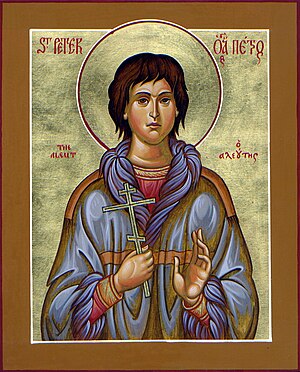
Peter the Aleut is perhaps the most obscure Orthodox saint associated with North America. Very little is known about him, except the account of his martyrdom. And even that is a bit fuzzy, having originated with the testimony of one eyewitness, and recorded in a handful of written reports.
Unfortunately, the transcript of the 1819 eyewitness testimony does not appear to have made it into English yet. It is supposed to have been published in the first volume of the Russian collection Russia in California (ed. by J. Gibson, A. Istomin, V. Tishkov; 2005), with a planned English translation to follow. But I can't find any indication that the English translation has appeared, and since I don't read Russian, it wouldn't do me any good to track down a copy of the original.
A copy of his testimony is said to have been included with the earliest formal report, sent back to St. Petersburg in 1820 by Simeon Ivanovich Yanovsky, chief manager of the Russian Colonies from 1818 to 1820. It would appear that the written testimony was in fact included, since the administrator of the Russian American Company sent a much longer account to Tsar Alexander I later that year. Yanovsky, who eventually became a monk, wrote 45 years later in a letter to Igumen Damascene of Valaam Monastery about his relating the event to St. Herman. It is this last account that is usually repeated in lives of St. Peter.
Yanovsky's 1865 letter is a logical choice for this purpose, not only because it feels more hagiographical than the other accounts, but also because it cites St. Herman himself acknowledging Peter's sainthood. From a historical standpoint, this endorsement may not mean much, but his reaction of simple faith can serve as an example for the rest of us.
Both of Yanovsky's letters are reproduced in The Russian Orthodox Religious Mission in America, 1794-1837. His superior's longer report was published a decade later, in The Russian-American Colonies, To Siberia and Russian America: Three Centuries of Russian Eastward Expansion. All three are quoted in an article by Raymond A. Bucko, S.J., which is helpfully available online, though quite negatively slanted.
A special problem with Peter's martyrdom is identifying the actual location. Both of the 1820 reports indicate that the hunting party was taken captive somewhere on the Bay of San Pedro in 1815, and the eyewitness returned and gave his testimony in 1819. There is no evidence of a mission at San Pedro, so they may have been taken 30 miles north to San Gabriel. From here we're told that most of the party was taken 100 miles west to Santa Barbara, but that only two were placed in prison. It is unclear whether this means they were left imprisoned at the original mission, or were taken on to Santa Barbara with the others and imprisoned there. The former scenario seems more likely, since we're told the eyewitness was taken to Santa Barbara after Peter's death.
Wednesday, December 1, 2010
singin' "this'll be the day that I die"
I guess I'm what you would call a historical drinker. I have no inclination to get drunk. I don't drink because I'm in any particular mood. I don't have much of a taste for many types of alcohol. I only drink socially sometimes. But most of my significant motivators have been historical.
In Akkadian class we learned about how Mesopotamia and Egypt were beer cultures, while Palestine was a wine culture. We read an article about how someone actually followed an ancient Sumerian recipe to brew a modern equivalent, and I remember thinking that it would be interesting to sample.
Sometime later, I was exploring Christmas traditions--actually trying to give more meaning to the season--and got interested in wassail. I never did come up with a good recipe, but I gave it a shot--that might be the first beer I ever bought. (Well, I think Julie bought it, but at my request.)
I reacted to the low-carb craze with indignation. Bread in one form or another has been a staple of just about every culture on earth. For most of human history, meat was too expensive to eat very often. I wanted nothing to do with a diet plan that reversed this trend. Drinking beer (liquid bread) was one form of rebellion.
More recently, I was looking up the differences between types of spirits out of curiosity. (Yes, that's what a serious drinker I am--three months ago, I couldn't have told you the difference between bourbon and brandy.) I noticed that several were tied to specific locales--bourbon to Kentucky, vodka to Russia, and of course scotch. I began to wonder--was there a spirit indigenous to Maryland?
Well, as it turns out, there is--or was. Before Prohibition, there were two main variants of American rye whiskey--Pennsylvania and Maryland. There was a minor revival of the industry after the ban was lifted, but over the next few decades labels went under or were sold off. Eventually, rye production--what remained of it--moved entirely to Kentucky. As it happens, the Pennsylvania variety survived almost exclusively. To my knowledge, the last rye to be produced in Maryland, and the only authentic Maryland style rye being distilled today, is Pikesville.
 Yes, "rye" is an actual drink, not just a delicious kind of bread. It makes a good deal more sense, now that I know what "them good old boys were drinking" with their whiskey in "American Pie" (the song, not the film). And appropriate, too, that the drink is featured in a song about death and memories. The Free State, where Governor Ritchie thumbed his nose at Prohibition, now has some of the toughest liquor laws in the Union and trucks its favorite drinks from elsewhere.
Anyway, lucky for me the stuff is cheap. At $13, it wasn't too big a risk to buy a bottle and give it a try. (And speaking of cheap, I've already figured out that, matched drink for drink, it's a good deal more economical than beer.) So, how has it gone?
 What? Diageo makes alcohol? Well, yes. As a matter of fact, they make Smirnoff, Johnnie Walker, Baileys, J&B, Captain Morgan, . . . they make a lot. But the reason for my double-take is that there's a Diageo plant just up Rt. 1, on the other side of the river in Relay. I've driven by it countless times--on the way to church, on the way to Walmart, on the way to get pit beef, etc. Pretty much everything around here sends you up or down Rt. 1, so odds are pretty good I'm going past the Diageo plant. I had no idea what they did.
I put up a comment on Facebook, and a friend who grew up in the area says it used to smell like whiskey driving Rt. 1 through Relay. Apparently it was once Maryland's largest distillery (including rye), back when it looked something like this:
 After Prohibition, Seagram's bought Calvert Distilling Company. Diageo bought Seagram's somewhere around 2000, but before that happened, the distilling operation in Relay shut down. I haven't discovered exactly what they do there now--distribution, and probably bottling? It doesn't smell like whiskey anymore, so I assume they're not distilling. They do, however, turn up here and there in lists of environmental violations, including something about radioactive materials--no idea what that is.
From Maryland rye to miscellaneous alcohol--the story of a state, the story of a town. Sometimes being a localist is just depressing.
In Akkadian class we learned about how Mesopotamia and Egypt were beer cultures, while Palestine was a wine culture. We read an article about how someone actually followed an ancient Sumerian recipe to brew a modern equivalent, and I remember thinking that it would be interesting to sample.
Sometime later, I was exploring Christmas traditions--actually trying to give more meaning to the season--and got interested in wassail. I never did come up with a good recipe, but I gave it a shot--that might be the first beer I ever bought. (Well, I think Julie bought it, but at my request.)
I reacted to the low-carb craze with indignation. Bread in one form or another has been a staple of just about every culture on earth. For most of human history, meat was too expensive to eat very often. I wanted nothing to do with a diet plan that reversed this trend. Drinking beer (liquid bread) was one form of rebellion.
More recently, I was looking up the differences between types of spirits out of curiosity. (Yes, that's what a serious drinker I am--three months ago, I couldn't have told you the difference between bourbon and brandy.) I noticed that several were tied to specific locales--bourbon to Kentucky, vodka to Russia, and of course scotch. I began to wonder--was there a spirit indigenous to Maryland?
Well, as it turns out, there is--or was. Before Prohibition, there were two main variants of American rye whiskey--Pennsylvania and Maryland. There was a minor revival of the industry after the ban was lifted, but over the next few decades labels went under or were sold off. Eventually, rye production--what remained of it--moved entirely to Kentucky. As it happens, the Pennsylvania variety survived almost exclusively. To my knowledge, the last rye to be produced in Maryland, and the only authentic Maryland style rye being distilled today, is Pikesville.
 Yes, "rye" is an actual drink, not just a delicious kind of bread. It makes a good deal more sense, now that I know what "them good old boys were drinking" with their whiskey in "American Pie" (the song, not the film). And appropriate, too, that the drink is featured in a song about death and memories. The Free State, where Governor Ritchie thumbed his nose at Prohibition, now has some of the toughest liquor laws in the Union and trucks its favorite drinks from elsewhere.
Anyway, lucky for me the stuff is cheap. At $13, it wasn't too big a risk to buy a bottle and give it a try. (And speaking of cheap, I've already figured out that, matched drink for drink, it's a good deal more economical than beer.) So, how has it gone?
- I figured I ought to start by trying it more or less unadulterated. I wasn't quite ready to start pounding shots (don't even own a shot glass), so I had it on the rocks. I don't know enough of the terminology to say what I didn't like about it, but I decided pretty quickly that I'd need to mix it somehow.
- My next attempt was a rye sour. That looked pretty simple to make and didn't require any ingredients I didn't already have. Success. The concoction was much more palatable.
- I'd seen somewhere that rye was the traditional base for a Manhattan. I didn't have vermouth or bitters, and I didn't want to buy them before knowing what I was getting into, so I ordered one while we were out for dinner. Maybe Red Lobster just doesn't make a good Manhattan, but it tasted almost exactly like cough syrup. Guess I'll stick with the sour.
- I also ran across a description of a hot toddy, which is essentially a whiskey sour served hot. Tried one of those the other day--that wasn't too bad either. OK, so now I have a couple of options for using up the bottle.
 What? Diageo makes alcohol? Well, yes. As a matter of fact, they make Smirnoff, Johnnie Walker, Baileys, J&B, Captain Morgan, . . . they make a lot. But the reason for my double-take is that there's a Diageo plant just up Rt. 1, on the other side of the river in Relay. I've driven by it countless times--on the way to church, on the way to Walmart, on the way to get pit beef, etc. Pretty much everything around here sends you up or down Rt. 1, so odds are pretty good I'm going past the Diageo plant. I had no idea what they did.
I put up a comment on Facebook, and a friend who grew up in the area says it used to smell like whiskey driving Rt. 1 through Relay. Apparently it was once Maryland's largest distillery (including rye), back when it looked something like this:
 After Prohibition, Seagram's bought Calvert Distilling Company. Diageo bought Seagram's somewhere around 2000, but before that happened, the distilling operation in Relay shut down. I haven't discovered exactly what they do there now--distribution, and probably bottling? It doesn't smell like whiskey anymore, so I assume they're not distilling. They do, however, turn up here and there in lists of environmental violations, including something about radioactive materials--no idea what that is.
From Maryland rye to miscellaneous alcohol--the story of a state, the story of a town. Sometimes being a localist is just depressing.
Thursday, November 25, 2010
Thanksgiving
Our parish observes this American holiday at Wednesday compline by singing the Akathist of Thanksgiving. It's not what you might think. Although the Akathist was composed quite recently, it had nothing to do with Pilgrims and sweet potatoes. The hymn is attributed to a priest Gregory Petrov and is said to have been discovered after his death in a Soviet prison camp. I liken it to the Mourner's Kaddish in Jewish tradition, which is recited by those who have recently lost a loved one. The prayer itself seems to have nothing to do with mourning but is rather a beautiful praise to God. Similarly, the Akathist was apparently written amid intense suffering, but its focus is praise for God's manifold goodness. In both cases, the message seems to be that our greatest need to offer praise and thanksgiving is when things aren't going so well--when the only alternative is to slander God for his silence, laziness, or capricious violence.
Still, if we need such expressions most when life is at its worst, that hardly means they can't apply as well in less dire circumstances. So I think it's a good meditation for Thanksgiving Day and probably for the rest of the year. I actually went through the hymn not long ago to pull out some lines that might be useful to memorize for various occasions. In some Jewish prayer books there is a section of short blessings to be said in situations that might come up as we go through our daily lives. I thought it would be nice to have something comparable to work with, though admittedly I haven't thought much about it since.
Anyway, here's the list I came up with. (Certainly there could be others.) A few bracketed items were actually drawn from other blessings, but most of what's here is from the Akathist.
Still, if we need such expressions most when life is at its worst, that hardly means they can't apply as well in less dire circumstances. So I think it's a good meditation for Thanksgiving Day and probably for the rest of the year. I actually went through the hymn not long ago to pull out some lines that might be useful to memorize for various occasions. In some Jewish prayer books there is a section of short blessings to be said in situations that might come up as we go through our daily lives. I thought it would be nice to have something comparable to work with, though admittedly I haven't thought much about it since.
Anyway, here's the list I came up with. (Certainly there could be others.) A few bracketed items were actually drawn from other blessings, but most of what's here is from the Akathist.
Food
- Feast: Glory to Thee for the feast of life!
- [Bread: Glory to Thee, who didst bless the five loaves and didst therewith feed the five thousand!
- Meat: Glory to Thee, who didst command the fatted calf to be slain for thy son who had gone astray, and who had returned again to Thee!]
- Fruit: Glory to Thee for the delightful diversities of berries and of fruits!
- [Wine: Glory to Thee, who permittest the fruit of the vine to come to maturity!
- Other: Glory to Thee, the Creator and Maker of all things!]
Fragrance
- Flowers: Glory to Thee for the perfume of lilies-of-the-valley and of roses!
- Other: Glory to Thee Who hast brought forth from the earth’s darkness diverse colours, taste, and fragrance!
Daily Cycle
- Morning: Glory to Thee for the diamond brilliance of morning dew!
- Sunrise: Glory to Thee for the smile of light awakening!
- Meditation: Glory to Thee for the happiness of living, moving, and meditating!
- Manual Labor: Glory to Thee for the vivifying power of labour!
- Service: Glory to Thee, Who transfigurest our life by good deeds!
- Reward for Service: Glory to Thee, Who dost vouchsafe great rewards for precious good deeds!
- Sunset: Glory to Thee for the farewell rays of the setting sun!
- Evening: Glory to Thee in the tender hour of evening!
- Night: Glory to Thee for Thy favour in the darkness, when all the world is distant!
- Sleep: Glory to Thee for the rest of grace-filled sleep!
Encounters
- Family/Friends: Glory to Thee for the love of kindred, and the faithfulness of friends!
- Catechumen: Glory to Thee Who hast founded Thy Church as a quiet refuge for a spent world!
- Newly Illumined: Glory to Thee Who renewest us by the life-giving waters of baptism!
- Secular Thinker: Glory to Thee for the genius of the human mind!
- Scripture/Saint: Glory to Thee for the fiery tongues of inspiration!
- Other People: Glory to Thee for providential meetings with people!
- Domestic Animals: Glory to Thee for the meekness of animals which serve me!
- Wild Animals: Glory to Thee, for the thousands of Thy creatures Thou hast set round about us!
- Nature: Glory to Thee Who hast revealed unto me the beauty of the universe!
- Science: Glory to Thee Who hast shown Thine unfathomable power in the laws of the universe!
- Revelation: Glory to Thee for all that Thou hast revealed unto us by Thy goodness!
- Mystery: Glory to Thee for all that Thou hast concealed in Thy wisdom!
- Grief: Glory to Thee, Who sendest failures and sorrows, that we might pity the sufferings of others!
- Passage of Grief: Glory to Thee Who curest sorrows and bereavements with the healing passage of time!
- Confession: Glory to Thee, Who restorest to penitents purity as a spotless lily!
- Providence: Glory to Thee for providential coincidence of circumstances!
Subscribe to:
Posts (Atom)