Showing posts with label Orthodoxy. Show all posts

Monday, April 23, 2012

altar boy

So, Ian's an altar boy. In our parish, they can start at age nine. He wasn't interested when I initially asked him about it, but after his friend David told him how great it is, he changed his mind. Since his birthday was coming up anyway, they decided to start him during Holy Week. The original plan was to begin with the Unction service on Wednesday, but he got sick early in the week, and it seemed too soon to throw him into something new. We skipped that opportunity and started him instead on Holy Saturday.

I think he likes it. Since that first time, he's asked before every service if he was serving in the altar again. He wasn't actually scheduled until next month, but we did manage to get him a walk-on this week. They don't really do formal substitutions. If someone doesn't show up (on time), they just grab someone to fill in. Since he wanted to serve, we made sure to arrive early yesterday, and it paid off. For some reason, they finished Matins 15 minutes ahead of schedule, so in the scramble to make sure everything was ready to go for the Liturgy, I asked if they could use one more, and they took him.

I'm sure the thrill will wear off eventually, but it's nice for now. I figured he'd do better with some kind of responsibility to keep him occupied during the services, and just getting him and Jenna apart helps everyone. Once Ian settles into a routine, I'll see if I can get her to stand with the choir again. She was into it for a while, since several of the girls stand back there, but she might feel better about it if I can be in closer proximity.

Anyway, Holy Saturday. I don't think most people know what to do with it. Sure, there's Good Friday, when Jesus died on the cross, and of course Easter, when he rose from the dead. But the Gospels don't really spend much time on that day in between. It was the Sabbath, and his disciples rested as they were supposed to. As far as that goes, in one sense we can say that Jesus rested as well. He had completed his work of suffering and dying--really, he had completed his earthly life. By all appearances, he was resting. But we also think of this time as quite active. His soul was in Hades, preaching victory to "the spirits in prison."

In current Orthodox practice, the observance of Holy Saturday actually begins Friday night with the Lamentations service. But even as depressing as that sounds, it contains a great deal of hope in what will soon follow. By the time we get to Holy Saturday itself, the Liturgy is actually attached to Vespers, which really makes it the end of Holy Saturday and the beginning of Easter. So there's a great deal about salvation and victory, which culminates before the Gospel reading, as the altar party processes around the nave and the priest throws bay leaves.


Holy Saturday is also the Traditional day for baptisms. Catechumens would sometimes spend years preparing for baptism. The home stretch was Lent, with forty days of training and spiritual preparation. During Holy Week, they would finally learn about communion. It was actually kind of unusual that we didn't have any baptisms on Holy Saturday this year, but we sing "As many of you as have been baptized . . . " in any case. Guess it was a good day to "baptize" Ian into his new role in the altar.

Sunday, April 15, 2012

a preterist view of the zombie apocalypse

To me, one of the more fascinating events in the Gospels is Matthew's account of what happened when Jesus died on the cross:
At that moment the curtain of the temple was torn in two from top to bottom. The earth shook, the rocks split and the tombs broke open. The bodies of many holy people who had died were raised to life. They came out of the tombs after Jesus’ resurrection and went into the holy city and appeared to many people. (Matt 27:51-53)
The NIV rendering, given here, includes in a footnote an alternate translation of the last sentence: "They came out of the tombs, and after Jesus' resurrection they went into the holy city and appeared to many people." The Greek text is ambiguous, but this minority reading doesn't seem very popular. It shows up in Wycliffe and the Good News Bible, but not in most mainstream English versions.

Perhaps it would seem a bit too ominous if the tombs broke open on Friday and nothing came out until Sunday. It might also make more sense, as St. Chrysostom suggests, that the death cry of Jesus raised them:

And together with these things He showed Himself also by what followed after these things, by the raising of the dead. For in the instance of Elisha; one on touching a dead body rose again, but now by a voice He raised them, His body continuing up there, on the cross.
This is an interesting parallel to contemplate. He refers here to the incident recorded in 4 Kingdoms (2 Kings) 13:21, in which a corpse inadvertently touches the bones of the prophet Elisha and is raised to life. St. Chrysostom is saying that this popular proof-text for saints' relics also prefigures the effect of Jesus's cry on the cross. So much greater than the greatest Old Testament prophets, no physical contact is necessary, but merely his final shout of victory breaks open the ground and calls forth the saints of old.

We might also surmise that if the raising was meant primarily as a sign of Jesus's own pending resurrection, it would need to show some manifestation beforehand. St. Chrysostom again:
Again they said, “He saved others, Himself He cannot save,” but He while abiding on the cross proved this most abundantly on the bodies of His servants. For if for Lazarus to rise on the fourth day was a great thing, how much more for all those who had long ago fallen asleep, at once to appear alive, which was a sign of the future resurrection. For, “many bodies of the saints which slept, arose,” it is said, “and went into the holy city, and appeared to many.” For in order that what was done might not be accounted to be an imagination, they appear, even to many, in the city.
Still, I have to wonder: what were these raised saints doing for three days in or among the tombs? Were they such scrupulous observers of the Sabbath that they sat quietly and waited until they could travel forth on Sunday? Or were they just wandering aimlessly among the tombs like so many zombies, lacking the intelligence to find a way out? Or did it take them three days to reach Jerusalem at some slow, stilted pace? Perhaps many of them came from great distances, and they mustered at some staging location outside the city before entering on Sunday.

Whichever translation one prefers, it still must have been a shocking event. We're given no details of their appearance. Presumably people knew whom they were seeing, but how? Period clothing? Accent? Did they have accurate depictions of them to compare? Or did their appearance somehow betray that they were recently raised from the dead? Blessed Theophylact, in his Explanation of Matthew, doubts that this was a final resurrection. If they were raised only temporarily, to return to their graves a few days later, what kind of bodies would they have had?


In the debates surrounding interpretation of the Apocalypse, the Preterist view is that which sees many of the images fulfilled in the first century--in the events surrounding Jesus's death and resurrection, the ministry of the Apostles, and the destruction of Jerusalem. Might we not take Matthew's account here as favoring a Preterist view of the Zombie Apocalypse?

Tuesday, April 3, 2012

a chronological note

Although I don't know whether I'll be posting anything between now and Easter, it occurred to me that whatever I do post may be confusing to non-Orthodox. What follows is typically tedious, but it may help clarify things. If you start to get drowsy, just skip to the last paragraph.

To my knowledge, all Christian traditions agree on the basic scheme for scheduling Easter. According to the Gospels, Jesus rose from the dead on the first Sunday after Jewish Passover, which always fell in the middle of the lunar month Nisan, which was always the first month of spring. In keeping with this, Easter always falls on the first Sunday after the first full moon after the first day of spring. This system, incidentally, incorporates the three major features of our calendar--the spring equinox for the solar year, the full moon for the lunar month, and Sunday for the seven-day week ordained by God. Where the traditions differ, however, is in the determination of spring.

According to the system set down at the first Ecumenical Synod of Nicea (AD 325), the start of spring for purposes of calculating Easter was fixed at March 21 of the Julian calendar, which at that time was the universal calendar of the Roman Empire. Up until around this time, the Jewish month of Nisan was determined by observation, much like Muslim Ramadan is set to this day. The difference was that the Jewish calendar adjusted for the solar year by adding a leap month if various indicators suggested that it was not yet spring. Christianity, however, did not follow a lunar calendar, so a calculated date for Easter made more sense. Also, because Christianity ended up preceding Easter with several weeks of Lent, it was necessary to know when to start the movable cycle long before the first moon of spring could be observed.

The system worked fine until the sixteenth century, when the Latin Pope Gregory XIII approved a reform of the Julian calendar. Scholars had noted that the calendar was growing increasingly out of sync with the astronomical data and would continue to do so as long as the solar year was not precisely 365.25 days long. Instead of every year divisible by four being a leap year, they proposed that century years no longer be leap years, unless they were divisible by 400. This would shorten the calendar by three days every 400 years and align it more closely (but still not precisely) with the actual solar year. To correct the divergence that already existed, they went back to the year 100 and adjusted accordingly. This means that right now the Gregorian calendar lags behind the Julian by 13 days. After 2/28/2100, the difference will increase to 14 days.

The Gregorian calendar was not accepted all at once. The newly Protestant countries of Europe were not keen to accept a papally-decreed reform. The British Empire didn't come around until the eighteenth century, just a few decades before the American Revolution. Eastern Europe was even slower, waiting mostly until the twentieth century to change its civil calendar. By that point, much of Eastern Europe was coming under Communist control, and Christians resisted any meddling with the ecclesiastical calendar. After failure to adopt the full Gregorian reform, a compromise was enacted in some Orthodox churches, called the Revised Julian or New Calendar. It accepts the Gregorian system for the fixed calendar but continues to reckon Easter by the Julian date of March 21. The result is that, with few exceptions, Orthodox churches celebrate Easter and Pentecost according to the Julian calendar, while on fixed holidays like Christmas and Epiphany they are divided between Julian and Gregorian. (Loosely, one can say that Greeks follow the New Calendar while Slavs follow the Old, but this leaves out a lot of important nuances.)

All of which is to say that, in any given year, Orthodox Easter might coincide with Western Easter, or it might come a week or even a month later. (The variance is because shifting March 21 by 13 days may also affect by a couple of extra weeks how long it is until the first full moon.) It seems to be least confusing when they coincide or fall far apart. This year, they are separated by a week, so when you're thinking Easter, we'll be thinking Palm Sunday. But just to keep things interesting, we'll both be ending Lent at the same time. In Eastern reckoning, Lent is counted every day and precedes Holy Week; in the West, Sundays aren't counted and Lent includes Holy Week.

Monday, April 2, 2012

Introverts of the World Unite! (well, maybe in a newsgroup)

I believe it was through Google+ (not surprisingly) that I first discovered Susan Cain. The brief article was enough motivation to request her book from the library, and several months later (so many introverts using libraries?) I finally got a chance to read Quiet: The Power of Introverts in a World that Can't Stop Talking.

It was not exactly surprising that, of the 20 questions designed to suggest whether one's personality tends more toward the introvert or extrovert end of the spectrum, I answered "true" every time. I already knew why I was reading the book. But it didn't take long for Cain to reveal some interesting connections in my own psyche--again, not earth-shattering surprises, but worthy of reflection nonetheless.


Migration


Extroversion is in our DNA--literally, according to some psychologists. The trait has been found to be less prevalent in Asia and Africa than in Europe and America, whose populations descend largely from migrants of the world. It makes sense, say these researchers, that world travelers were more extroverted than those who stayed home--and that they passed on their traits to their children and their children's children.
This is an interesting observation as it tries to explain why Americans favor extroversion, but more interesting to me was the general consideration that extroverts are more likely to migrate, while introverts stay put. A fairly defining trait in my life has been my affinity for staying put, but I never really thought much about its possible connection to introversion. I don't suppose I would, considering that my prime counterexamples are my parents and maternal grandparents, none of whom would I categorize as extroverts. But throughout most of my adult life I've struggled with this migratory tendency in my family, and in the past few years I've come to hold as a fundamental value the love of place. For me, rootedness just seems more naturally human, which is not to say that there aren't other, competing impulses that deserve attention, or that it doesn't sometimes take a lower priority. But in general, I view placelessness as an anomaly, whose popularity has come only in the past century or so. This has an interesting coincidence with the next connection:


Industrialization

[Dale] Carnegie's journey reflected a cultural evolution that reached a tipping point around the turn of the twentieth century . . . . America had shifted from what the influential cultural historian Warren Susman called a Culture of Character to a Culture of Personality--and opened up a Pandora's Box of personal anxieties from which we would never quite recover.

In the Culture of Character, the ideal self was serious, disciplined, and honorable. What counted was not so much the impression one made in public as how one behaved in private. . . .

But when they embraced the Culture of Personality, Americans started to focus on how others perceived them. They became captivated by people who were bold and entertaining. . . .

The rise of industrial America was a major force behind this cultural evolution. The nation quickly developed from an agricultural society of little houses on the prairie to an urbanized, "the business of America is business" powerhouse. . . .

Americans found themselves working no longer with neighbors but with strangers. "Citizens" morphed into "employees," facing the question of how to make a good impression on people to whom they had no civic or family ties.
Along with my developing conviction that humans are better off attached to a place, I have tended to favor the ideal of a more agrarian life. As Cain notes, the major shift came around the beginning of the 20th century, which is not precisely when industrialization took hold, but still marks a watershed in the development of American culture. I would suggest that increased mobility played a critical role in this shift, as well as the apparent wealth generated by industry of the previous generation. Once people had the disposable income to buy and industry had the increased capacity to produce consumer goods, salesmanship became the new driving force behind cultural norms--a trend that Cain highlights as crucial in the rise of Personality, or idealized extroversion.

The Culture of Character, on the other hand, seems to have no particular origin. I would say that "serious, disciplined, and honorable" are traits favored by just about every traditional society--certainly those we would characterize as European, whether Christian or Classical. I realize I'm probably biased here by my introvert tendencies, but my gut reaction is that it would be downright immoral to deny these qualities their place in society. I'm not trying to impugn the masses of people who have bought into the Culture of Personality, but it's hard for me to imagine anyone, when faced with the two Cultures in the stark contrast of their ideals, favoring the shift toward Personality.


Evangelicalism

"The evangelical culture ties together faithfulness with extroversion," McHugh explained. "The emphasis is on community, on participating in more and more programs and events, on meeting more and more people. It's a constant tension for many introverts that they're not living that out. And in a religious world, there's more at stake when you feel that tension. It doesn't feel like 'I'm not doing as well as I'd like.' It feels like 'God isn't pleased with me.'"
My own thinking about place and culture developed concurrently (and perhaps a bit paradoxically) with a move away from my Evangelical roots toward Traditional Christianity. I won't deny that I always felt conflicted about this process, since in a way I was doing the very thing I criticized--looking for contentment by uprooting and settling somewhere else. Just because it was an intellectual and spiritual uprooting didn't make it any less of a contradiction. But I tolerated the move, because I was convinced that Evangelicalism itself was part of the problem. As an American movement, it was perhaps inevitable that it would embrace the Culture of Personality. But even this, I think, is symptomatic of a deeper problem. Bereft of a stable Tradition, Evangelicalism has tended to mimic whatever trends are popular in the culture at large. It earnestly tries to be biblically based, but its growth strategies, leadership models, and vision statements have long reflected those found in the business world.

I would be interested to read McHugh's book after this, since he writes as an insider. I don't think Cain exhibits a particularly precise familiarity with Evangelicalism, but I don't expect her to, either. The basic point of this brief section, which is captured in the quote above, I would consider fundamentally sound. Again, it wasn't news to me, but reading this section of the book shed some light on remarks that were made by the leadership of our former church, shortly before I began the formal process of conversion to Eastern Orthodoxy:
We sense that Trevor’s desire for conversion may well be based on mixed impulses. We don’t say this in any sense of condemnation, but just as an observation that is in accord with biblical instruction concerning human nature: Specifically, we can see how Orthodoxy appeals to both the core identity of who Trevor is (scholar, teacher, mystic (as image bearer and new creation)); but we also sense that it appeals to aspects of woundedness, both personal and generational that should be acknowledged. . . . we are concerned that Orthodox practice also has the potential to allow someone to continue to be disengaged from community life. Our sense is that God would have Trevor grow in his capacity for relational engagement (when in intimate personal settings). Historically, we have observed that Trevor is very engaging and transparent by email (and in his blog) – but fails to engage at a similar level in person. Thus, our concern expressed in this point is that Orthodoxy could be a place for Trevor to hide from necessary life change.
Five years of distance and a little more learning about personality have given me a slightly different perspective on these remarks than I had initially. They acknowledge my core identity (clumsily summarized as "scholar, teacher, mystic"), but then go on to implicate my "capacity for relational engagement" as an aspect of "woundedness." What they describe (and what they don't) are classical traits of an introverted personality--a preference for written communication, and favoring substantive discussion over small talk. The latter point isn't clear from this paragraph, but in associated discussion I was told, "there is no such thing as small talk," meaning that it is a necessary part of community life and that my failure to excel at it reflects a corresponding failure in my ability to engage. I would point out as well that how one defines "relational engagement (when in intimate personal settings)" depends heavily on one's personality and perspective. As an introvert, and without knowing what the speaker intended, I would generally assume that it refers to one-on-one interaction with someone you already know on an intimate level. But since the words were written by someone who had no way of knowing how I performed in such settings (our interactions had never risen above the level of small talk, and that very clumsily done), I'm inclined to think they met something very different here by the words "intimate" and "personal"--something more akin to "informal" and "casual"--which, as I say, would make it primarily a criticism of my introverted personality.

None of this is to say that all Evangelicals are so blatantly biased against introversion. But I would turn the argument around and charge that Evangelicalism uniquely fosters a preference for extroversion--that it often becomes "a place for [extroverts] to hide from necessary life change." The Orthodox Church (and I suspect the Roman Catholic and other forms of traditional Christianity) certainly makes more room for introversion, but I would call it a healthy balance. There is room for both extroverts and introverts each to play their own roles. Extroverts are encouraged to learn silence, and introverts are discouraged from misanthropy--neither type should give free rein to its negative tendencies. And this is precisely what we should expect from catholic Christianity--a place for everyone.

I never considered my introversion a fundamental reason for my conversion, but it certainly does play its role, as it does in my views on society. I think it's healthy to think in such terms now and then, as long as it doesn't involve reducing everything to one subconscious cause.

Monday, June 27, 2011

1812 Overture

Ft. McHenry is one of the few places where I can feel patriotic. Although it was used to imprison Maryland legislators suspected of favoring secession, it was also where the Battle of Baltimore was fought and won. The War of 1812 may have been a silly war, but at least here in Maryland it wasn't for the sake of American expansion. Here, it was about freedom from British control, plain and simple. Our clippers harried British ships, and when we came under full-scale attack, our well-prepared defenses won the day. The Star Spangled Banner may be our national anthem, but its home is in Baltimore.

While poking around online for information about the War of 1812, I came across a reference to the 1812 Overture. I knew about it, of course--a popular tune at Independence Day celebrations, during fireworks displays, and the music to which V set his explosions in V for Vendetta. If I'd had to guess, I would have supposed it to have some connection with our War of 1812. Not only would I have been wrong, but I would have had twice the reason to be embarrassed.

The same series of Napoleonic Wars that led Britain to blockade American ports also saw the invasion of Russia. But Napoleon stretched his army too far, and he was forced to retreat, losing most of his men along the way. Tsar Alexander I commissioned the building of Christ the Savior Cathedral as a thank-offering, and it was completed 68 years later amid festivities. It was at that point that Tchaikovsky wrote the Overture to commemorate the battle. The piece includes two renditions of the troparion of the Holy Cross, which had been something like the Byzantine national anthem and was often used in times of great distress as a corporate prayer for deliverance. It's a familiar tune to me--my local parish is dedicated to the Holy Cross, so we sing the troparion pretty much every Sunday.

Apparently Tchaikovsky was very popular in America during his lifetime, and his composition was just so well-suited to the 4th of July! It's one of the few classical pieces written for cannons. So despite Cold War concerns about all things Russian, its popularity has survived the 20th c. largely intact. I suspect that most Americans have no idea where it originated or what it's about. (At least, it makes me feel better to think that I'm not the only one.) It's just another selection in our patriotic repertoire.

Which is fine with me. I'll quietly look forward each year to hearing the former Byzantine and Russian national anthems played prominently for American Independence Day.

Monday, May 2, 2011

from the Akathist for the Repose of Those Who Have Fallen Asleep

I'm no friend of Osama bin Ladin, and I'm not about to dispute whether he deserved to die. Still, as Gandalf told Frodo, "Many that live deserve death. And some that die deserve life." If we can't give the latter, we shouldn't be too quick to cry for the former either.

The verse from Proverbs that you often hear quoted is interesting:
Rejoice not when thine enemy falleth, and let not thine heart be glad when he stumbleth (24:17)
but mostly, I think, for the words that follow:
Lest the LORD see it, and it displease him, and he turn away his wrath from him.
Proverbs is mostly common sense wisdom about the world around us, and as such, it is often messy. We'd like this to be a more exalted standard--love your enemy as God does, or some such thing. But no, the point here is that God may care more about teaching you a lesson in humility than about justly executing your neighbor. Or to put it in more secular terms, dancing in the streets over the death of our opponent may have more far-reaching consequences than the death itself.

But for Christians, the standard is Jesus, is it not? He who rebuked his disciples for wanting to call down fire from heaven. He who forgave his enemies while they were putting him to death. He who told us to love and pray for our enemies. I know it's not an easy standard, but what good would it be if it were? This is one of the things I love about liturgical prayer. There's no rule that says we must pray in the words of the Church, though we are certainly supposed to pray with her heart. When we don't know how to do that, we have a wealth of model language to help us. Here, then, are a few pertinent sections from the Akathist for the Repose of Those Who Have Fallen Asleep:

Kontakion 2

Enlightened by the illumination of the Most High, Saint Macarius heard a voice from a pagan skull: "When you pray for those suffering in Hell, there is relief for the heathen." O wonderful power of Christian prayer, by which even the infernal regions are illumined! Both believers and unbelievers receive comfort when we cry for the whole world: ALLELUIA.

Ikos 3

O Glad Light, Redeemer of the world, embracing the whole universe with Thy love: behold, Thy cry from the Cross for Thine enemies is heard: "Father, forgive them." In the name of Thine all-forgiving love we make bold to pray to our Heavenly Father for the eternal repose of Thine enemies and ours.
Forgive, O Lord,
those who have shed innocent blood,
those who have sown our path of life with sorrows,
those who have waded to prosperity through the tears of their neighbors.
Condemn not, O Lord,
those who persecute us with slander and malice.
Repay with mercy those whom we have wronged or offended through ignorance,
and grant that our prayer for them may be holy through the sacrament of reconciliation.
O Lord of unutterable Love, remember Thy servants who have fallen asleep.

Kontakion 5

Thou hast given us death as a last prodigy to bring us to our senses and to repentance, O Lord. In its threatening light, earthly vanity is exposed, carnal passions and sufferings become subdued, insubmissive reason is humbled. Eternal justice and righteousness opens to our gaze, and then the godless and those burdened with sins confess on their deathbed Thy real and eternal existence and cry to Thy mercy: ALLELUIA.

Ikos 5

O Father of all consolation and comfort, Thou brightenest with the sun, delightest with fruits, and gladdenest with the beauty of the world both Thy friends and enemies.
And we believe that even beyond the grave Thy loving kindness,
which is merciful even to all rejected sinners, does not fail.
We grieve for hardened and wicked blasphemers of Thy Holiness.
May Thy saving and gracious will be over them.
Forgive, O Lord,
those who have died without repentance.
Save those who have committed suicide in the darkness of their mind,
that the flame of their sinfulness may be extinguished in the ocean of Thy grace.
O Lord of unutterable Love, remember Thy servants who have fallen asleep.

Kontakion 6

Terrible is the darkness of a soul separated from God, the torments of conscience, the gnashing of teeth, the unquenchable fire and the undying worm. I tremble at the thought of such a fate, and I pray for those suffering in Hell as for myself. May our song descend upon them as refreshing dew as we sing: ALLELUIA.

Ikos 6

Thy light, O Christ our God, has shone upon those sitting in the darkness and shadow of death and those in Hell who cannot cry to Thee. Descend into the infernal regions of the earth, O Lord, and bring out into the joy of grace Thy children who have been separated from Thee by sin but who have not rejected Thee.
For they suffer cruelly. Have mercy on them.
For they sinned against Heaven and before Thee,
and their sins are infinitely grievous,
and Thy mercy is infinite.
Visit the bitter misery of souls separated from Thee.
Have mercy, O Lord, on those who hated the truth out of ignorance.
May Thy love be to them not a consuming fire
but the coolness of Paradise:
O Lord of unutterable Love, remember Thy servants who have fallen asleep.

Monday, December 27, 2010

six geese a-laying

It recently occurred to me that I was literally born to celebrate Christmas in the traditional order. What do I mean? Well, let me start with the order. These days, the Christmas season starts sometime in November. I suppose at this point, you'd have to say the "traditional" start is black Friday. Curmudgeons grumble when decorations and piped-in Christmas carols appear before Thanksgiving. The proper start is to haul out the decorations the weekend after, get a live tree if that's your thing, and start shopping, baking, etc. It's the season of church and office parties, all leading up to the main event on December 25. Once the presents are opened, food is packed away, and guests have gone home, it's time to take down the decorations. If you're especially lazy or busy traveling, you might let things go until New Year's.

But it wasn't always that way. We still sing about 12 days of Christmas. Some of us might even have a vague awareness of the Twelfth Night--either as a Shakespearean title or as a geeky excuse to drag out the Renaissance Fair costumes in winter. But what does it mean? 12 days, staring from December 25; that takes you to January 5. Why? Because Epiphany (Theophany in the East) falls on January 6--the next big feast on the calendar ends the Christmas season. Note: the traditional season does not end but starts on December 25. Formally, it ends at Epiphany, but in some places the celebration can actually extend into February.

Traditionally, the season before Christmas Day was Advent--the preparation for the feast. Instead of a month of lesser parties, Christmas songs, and shopping, you had 40 days of fasting, prayer, and almsgiving. It was a preparation of the heart for the feast. This is still a common observance among Eastern Orthodox. Among Western Christians, there is sometimes the positive spiritual preparation of the Advent Wreath. I've even spoken with at least one person who knew about an ascetic pre-Christmas season that might preclude listening to Christmas music. I don't think he was Orthodox--perhaps there are vestiges in Roman Catholic practice as well.

But generally speaking, the greatest hardship of the Advent Fast these days is how it runs counter to what everyone else is doing. For a month leading up to Christmas, you must politely abstain from offered foods or other aspects of our culture's pre-celebration. Then, the day finally arrives, and once again you're out of sync. You're finally ready to celebrate, but everyone else wants to put away the decorations and move on to something else.

Fortunately, there is New Year's Eve, which we can all celebrate together. (Apologies--and sympathy--to those of you still following the Julian calendar.) But aside from that, it's hard--especially for an introvert like me--to keep the celebration going on my own. Having visiting family helps--you retain something of a festive atmosphere just because you're together with those you don't see often.

But the point of all this is that my birthday also helps. I was born on the sixth day of Christmas, so I get the advantage of an extra excuse to celebrate. This realization not only encourages me in my feeble attempts to do something with the season; it's also a positive spin on something I've long lamented--the fact that my birthday comes so close to Christmas. And I'm happy to sacrifice December 30 as "my day," if it contributes to his.

Tuesday, December 14, 2010

sources on St. Peter


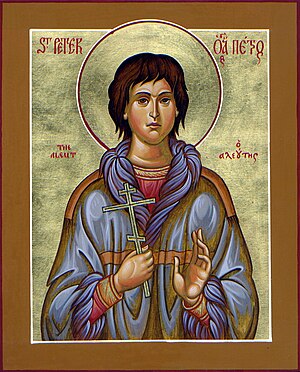
Peter the Aleut is perhaps the most obscure Orthodox saint associated with North America. Very little is known about him, except the account of his martyrdom. And even that is a bit fuzzy, having originated with the testimony of one eyewitness, and recorded in a handful of written reports.

Unfortunately, the transcript of the 1819 eyewitness testimony does not appear to have made it into English yet. It is supposed to have been published in the first volume of the Russian collection Russia in California (ed. by J. Gibson, A. Istomin, V. Tishkov; 2005), with a planned English translation to follow. But I can't find any indication that the English translation has appeared, and since I don't read Russian, it wouldn't do me any good to track down a copy of the original.

A copy of his testimony is said to have been included with the earliest formal report, sent back to St. Petersburg in 1820 by Simeon Ivanovich Yanovsky, chief manager of the Russian Colonies from 1818 to 1820. It would appear that the written testimony was in fact included, since the administrator of the Russian American Company sent a much longer account to Tsar Alexander I later that year. Yanovsky, who eventually became a monk, wrote 45 years later in a letter to Igumen Damascene of Valaam Monastery about his relating the event to St. Herman. It is this last account that is usually repeated in lives of St. Peter.

Yanovsky's 1865 letter is a logical choice for this purpose, not only because it feels more hagiographical than the other accounts, but also because it cites St. Herman himself acknowledging Peter's sainthood. From a historical standpoint, this endorsement may not mean much, but his reaction of simple faith can serve as an example for the rest of us.

Both of Yanovsky's letters are reproduced in The Russian Orthodox Religious Mission in America, 1794-1837. His superior's longer report was published a decade later, in The Russian-American Colonies, To Siberia and Russian America: Three Centuries of Russian Eastward Expansion. All three are quoted in an article by Raymond A. Bucko, S.J., which is helpfully available online, though quite negatively slanted.

A special problem with Peter's martyrdom is identifying the actual location. Both of the 1820 reports indicate that the hunting party was taken captive somewhere on the Bay of San Pedro in 1815, and the eyewitness returned and gave his testimony in 1819. There is no evidence of a mission at San Pedro, so they may have been taken 30 miles north to San Gabriel. From here we're told that most of the party was taken 100 miles west to Santa Barbara, but that only two were placed in prison. It is unclear whether this means they were left imprisoned at the original mission, or were taken on to Santa Barbara with the others and imprisoned there. The former scenario seems more likely, since we're told the eyewitness was taken to Santa Barbara after Peter's death.

Thursday, November 25, 2010

Thanksgiving

Our parish observes this American holiday at Wednesday compline by singing the Akathist of Thanksgiving. It's not what you might think. Although the Akathist was composed quite recently, it had nothing to do with Pilgrims and sweet potatoes. The hymn is attributed to a priest Gregory Petrov and is said to have been discovered after his death in a Soviet prison camp. I liken it to the Mourner's Kaddish in Jewish tradition, which is recited by those who have recently lost a loved one. The prayer itself seems to have nothing to do with mourning but is rather a beautiful praise to God. Similarly, the Akathist was apparently written amid intense suffering, but its focus is praise for God's manifold goodness. In both cases, the message seems to be that our greatest need to offer praise and thanksgiving is when things aren't going so well--when the only alternative is to slander God for his silence, laziness, or capricious violence.

Still, if we need such expressions most when life is at its worst, that hardly means they can't apply as well in less dire circumstances. So I think it's a good meditation for Thanksgiving Day and probably for the rest of the year. I actually went through the hymn not long ago to pull out some lines that might be useful to memorize for various occasions. In some Jewish prayer books there is a section of short blessings to be said in situations that might come up as we go through our daily lives. I thought it would be nice to have something comparable to work with, though admittedly I haven't thought much about it since.

Anyway, here's the list I came up with. (Certainly there could be others.) A few bracketed items were actually drawn from other blessings, but most of what's here is from the Akathist.

Food

  • Feast: Glory to Thee for the feast of life!
  • [Bread: Glory to Thee, who didst bless the five loaves and didst therewith feed the five thousand!
  • Meat: Glory to Thee, who didst command the fatted calf to be slain for thy son who had gone astray, and who had returned again to Thee!]
  • Fruit: Glory to Thee for the delightful diversities of berries and of fruits!
  • [Wine: Glory to Thee, who permittest the fruit of the vine to come to maturity!
  • Other: Glory to Thee, the Creator and Maker of all things!]

Fragrance

  • Flowers: Glory to Thee for the perfume of lilies-of-the-valley and of roses!
  • Other: Glory to Thee Who hast brought forth from the earth’s darkness diverse colours, taste, and fragrance!

Daily Cycle

  • Morning: Glory to Thee for the diamond brilliance of morning dew!
  • Sunrise: Glory to Thee for the smile of light awakening!
  • Meditation: Glory to Thee for the happiness of living, moving, and meditating!
  • Manual Labor: Glory to Thee for the vivifying power of labour!
  • Service: Glory to Thee, Who transfigurest our life by good deeds!
  • Reward for Service: Glory to Thee, Who dost vouchsafe great rewards for precious good deeds!
  • Sunset: Glory to Thee for the farewell rays of the setting sun!
  • Evening: Glory to Thee in the tender hour of evening!
  • Night: Glory to Thee for Thy favour in the darkness, when all the world is distant!
  • Sleep: Glory to Thee for the rest of grace-filled sleep!

Encounters

  • Family/Friends: Glory to Thee for the love of kindred, and the faithfulness of friends!
  • Catechumen: Glory to Thee Who hast founded Thy Church as a quiet refuge for a spent world!
  • Newly Illumined: Glory to Thee Who renewest us by the life-giving waters of baptism!
  • Secular Thinker: Glory to Thee for the genius of the human mind!
  • Scripture/Saint: Glory to Thee for the fiery tongues of inspiration!
  • Other People: Glory to Thee for providential meetings with people!

  • Domestic Animals: Glory to Thee for the meekness of animals which serve me!
  • Wild Animals: Glory to Thee, for the thousands of Thy creatures Thou hast set round about us!
  • Nature: Glory to Thee Who hast revealed unto me the beauty of the universe!
  • Science: Glory to Thee Who hast shown Thine unfathomable power in the laws of the universe!
  • Revelation: Glory to Thee for all that Thou hast revealed unto us by Thy goodness!
  • Mystery: Glory to Thee for all that Thou hast concealed in Thy wisdom!
  • Grief: Glory to Thee, Who sendest failures and sorrows, that we might pity the sufferings of others!
  • Passage of Grief: Glory to Thee Who curest sorrows and bereavements with the healing passage of time!
  • Confession: Glory to Thee, Who restorest to penitents purity as a spotless lily!
  • Providence: Glory to Thee for providential coincidence of circumstances!

Friday, April 2, 2010

Passion Gospels

I was curious about exactly how much material was covered in the twelve Passion Gospel readings. The passages are:
  1. John 13:31--18:1
  2. John 18:1-28
  3. Matt 26:57-75
  4. John 18:28--19:16
  5. Matt 27:3-32
  6. Mark 15:16-32
  7. Matt 27:33-54
  8. Luke 23:32-49
  9. John 19:25-37
  10. Mark 15:43-47
  11. John 19:38-42
  12. Matt 27:62-66
Now, the first obvious observation is that these readings do not include the full text of all four Gospels; nor, for that matter, do they contain the full text of any of the four Gospels. John dominates in terms of overall length, mostly because of the first reading, which consists of exclusive material--Jesus's teachings from the Last Supper. But even setting aside that reading, John still ties with Matthew for the most repeat visits. Indeed, it is hard to avoid the impression that the selection mostly revolves around John and Matthew, with Luke and Mark brought in for more thorough coverage of the crucifixion, death, and burial. This is a sensible strategy, given that Matthew is one of the more comprehensive of the Synoptic Gospels, while John's material regularly departs from that of the other three.

Even so, it should be expected that some of the material unique to Luke will be omitted, and that is in fact the case. Particularly, Luke's longer account of the walk to Golgotha is missing, and more notably, the entire hearing before Herod. The Synoptic account of Jesus's prayers in the Garden also fails to make the cut, but it does turn up in the composite reading from the preceding vespers.

The overall flow of the twelve readings is chronological, with a good deal of overlap:
  1. Johannine Last Supper teachings
  2. arrest, Jewish trial, denial (John)
  3. Jewish trial, denial (Matthew)
  4. Roman trial, mockery (John)
  5. Judas, Roman trial, mockery (Matthew)
  6. mockery, crucifixion (Mark)
  7. crucifixion, death (Matthew)
  8. crucifixion, death (Luke)
  9. crucifixion, death (John)
  10. burial (Mark)
  11. burial (John)
  12. guard (Matthew)
Again, it seems that emphasis is placed (as one would expect) on the actual crucifixion. This is the only section covered by all four Gospels, including the sole reading from Luke. The mockery is covered in three Gospels, as is the death. Indeed, there is a loose rise-and-fall to the whole series, from single coverage of the Johannine teachings to double coverage of each trial and Peter's denials, to the core events of the mockery, crucifixion, and death, then back to double coverage of the burial, and Matthew's account of the Jews requesting a guard.

I'm still a bit puzzled as to the omission of the hearing before Herod. Was it incidental, merely a by-product of the overall preference for John and Matthew? Or was it intentional, and if so, why? I'm probably just forgetting something, but I can't recall Herod being mentioned in the liturgical texts of Holy Week. That wouldn't necessarily explain the omission, but it would be consistent. Perhaps it was enough to show both the Jewish side and the Roman side in Jesus's death. Is Herod superfluous in that sense? He seems to have a unique perspective, being mostly interested in Jesus as a wonder-worker. It's an obsession that can preach, but perhaps in the overall message of Jesus's death, it's just not that important.

Tuesday, March 30, 2010

my story (or a version thereof)

In a group that Julie and I meet with, we've been discussing "our stories." I've long held the conviction that such things are necessarily selective and fluid, and rarely told the same way twice. So even though I've written down my story before, it's never come out quite this way. Read it as much for what it says about me now as for what it may say about my past:

My governing sins have always been in the areas of pride and vainglory. I have generally been confident in my own intellectual abilities, at the expense of everything else. I think I believed in God from as early as I can remember, but I didn't really start to take my faith seriously until I reached sixth grade. From that point on, I found ways to serve pride through religion.

My Sunday School teacher decided to pay students money as an incentive to read the Bible. That kind of mercenary spirituality would continue into my teen years, with quiz team and a camp scholarship program that required things like reading and Scripture memory. I also began to make friends with men in the church who were older than my parents. As a general practice, this could probably be a good opportunity for spiritual influence on youth, but in my case I saw it as another recognition of intellectual maturity beyond my years. They got me hooked on Christian apologetics, which encouraged me to "share my faith" through argumentation. Throughout high school, it became my personal crusade to show others that Christians (namely, I) could be intellectually respectable.

From time to time adults, impressed with my abilities, would suggest that I become a pastor. At first I scorned the idea, thinking that my intellectual abilities were too great for professional ministry. I had chosen engineering as a career when I was in fourth grade, and I wasn't ready to give up the opportunity to remind people of that choice. I spiritualized it by identifying a calling in my intellect--I, as a smart guy, was best suited to influence other smart guys. Anything less would be a waste of the talent God had given me. But my pride was multifaceted, and it wasn't long before I found a way to make professional ministry serve its ends.

I suppose there is probably some positive use to the notion of ministry as a higher calling, but it's hard for me to see it as anything better than a lesser evil. Men--especially men with a personality to lead--will generally take pride in their career. If they're going to explain why they chose the path of ministry, it will need to be framed as a step above whatever else they could have done. Hearing enough of this sort of thing eventually had its effect on me, and one summer I finally decided to throw my symbolic stick in the fire and dedicate my life to whatever God wanted me to do. Conveniently, God still wanted me to show off my intellect, just in a different field. I made a deal with him at that point--if he would save me from the embarrassment of a weak public speaking ability, I would go to Bible college. At the time, I really did believe that God must have made the difference; now, I'm not so sure it wasn't just the force of my own determination to excel in a different area. Either way, my pride remained.

My pastor tried to advise me against Bible college. He suggested getting a bachelor's degree in some other field, then going to seminary. That way I would have a fall-back career if I needed to support myself, and I would get a higher-level ministry education. I figured school was mostly just a formality anyway--I could learn whatever I needed to, when I needed to--so I wanted to get through it as quickly as possible. Worrying about a fall-back career would just be a sign of weakness. At the same time, I did recognize something about my own tendencies. I was genuinely concerned that if I gave myself too much opportunity I might choose something more comfortable than ministry. But the advice he gave was wiser than I imagined at the time, and it was arrogant to write it off so quickly.

In college, my focus began to shift away from apologetics to the core areas I was studying--Bible and theology. No longer surrounded by unbelievers who needed to be convinced that Christianity was true or respectable, I got my thrills from arguing with classmates about mostly pointless theological controversies. I was attracted (even when I disagreed) to the most intellectual and controversial of professors, and when authority clashed with heresy, I chose the latter. Even so, I had absorbed the narrow focus of the fundamentalist college I was attending. I ended up going on to seminary after all, and I chose one that was comfortably similar in doctrine but intellectually more rigorous.

Even going to seminary was a last-minute decision. It was not my original plan, but as I neared the end of my undergraduate studies, I realized that I was too young for the kind of job I really wanted. Also, school was comfortable for me and held less uncertainty than ministry. Many of the same trends continued in seminary, as I gravitated toward the areas that would be most intellectually challenging, most obscure, most academic. Not surprisingly, I decided before I was done that I would rather teach than pursue pastoral ministry, which meant I would have to go on for a Ph.D. But there was a spiritual dimension to this shift that took me longer to recognize.

I don't think I ever really had much of a true devotional life. In youth group, I was expected to keep a journal of prayer and scriptural meditation. It was checked regularly for completeness, but not at a level that would distinguish real interaction with God from intellectual contemplation of the assigned passages and meticulous maintenance of prayer lists. From time to time, college and seminary classes also required me to keep some kind of devotional journal, and I would comply as necessary. But aside from that, I generally assumed that my school work was spiritual enough. Early on, I developed a methodology for what I was doing. If the goal was to know and serve God better, I needed to understand what he expected of me. To understand that, I needed to grasp biblical theology and praxis. To grasp that, I needed to read and analyze Scripture intelligently. To read and analyze, I needed to get as close to the original texts as I could. And so, my intellectual pursuits were organized around acquiring the tools I needed to do all of this for myself, not to rely on anyone else's conclusions. Assuming I was actually working toward that goal, it all should have added up to spiritual growth, without adding anything else to the mix.

In the same way that I had no real relationship with God, after marriage, I had no real relationship with my wife. Most of my time was devoted to school and work. Even when we were together in our apartment, we were usually doing different things. I did not concern myself with what she wanted or even needed, and I justified it all as a temporary condition that would stop when I was done with school. But school dragged on, and things didn't change.

I was required to serve in church during college and seminary, and so I did. I genuinely cared about doing well whatever I was given, and I honestly looked for ways to apply my abilities to the greatest use. But I don't think it was ever an expression of love for God or even for other people. It was preparation for my chosen career, and I naturally wanted to do it well. But eventually my intellectual pursuits began to outpace other aspects of my life. I sensed a widening gulf between what I thought and what I did. And I knew that there were limits to what I could say out loud or apply in real life. My eccentricity was accepted to a degree, but church life was insufficiently flexible to accommodate full disclosure. That's when I realized that I could not be in paid ministry, whether I wanted to or not, and I also realized that I wouldn't have much future teaching in the kind of schools I'd attended.

So by the time I started my Ph.D. program, I was back to looking at the secular arena for my career. I figured that if necessary a Ph.D. in Semitic languages could be applied in a seminary, but I was really interested in teaching in a secular or at least not-so-fundamentalist college or university, where no one would care exactly what I thought about conclusions, as long as I could teach the right methods. It would probably have been less costly in terms of time, money, energy, and relationships if I'd just decided to pursue a different career altogether. But I was trying to save face, to prove to myself and others that I had not wasted the past several years of my life on a career that I would never pursue.

The crux came when I finished coursework on my Ph.D. and simultaneously became a father. In my self-centered pursuit of academic goals, we had put off having kids as long as we could. But now I had more freedom with how I used my time and more motivation to get things right. I somehow sensed that real life was becoming considerably more important than academia, and I pushed school to the back burner, in favor of sorting out more practical issues like faith and politics. I was still self-centered, to be sure, but I think it was an important step to open up my closed, little world to the influences of reality. I concluded pretty readily that I could not continue down the same "spiritual" path--which, as I said, was never really all that spiritual in the first place. But now it was intellectually impossible, like trying to go back and watch a magic show after you've seen how the trick works. No force of will can make you believe again.

I had followed the path to its end and found that it didn't really lead anywhere. Moving forward would mean making my own path (and knowing it). The only option that retained hope was to back up and turn aside into something altogether different. But I had become so jaded that even this move felt like I was still deliberately charting my own course--like there was no God to be found at the end, only more disappointment. But I could hold out hope that I would never get far enough to find out. I began exploring other faith traditions, looking for something that I could "live with"--something I could respect as honest about itself as a tradition, and intellectually challenging enough to hold my interest. I hadn't really changed all that much--it was still about what would make me feel a certain way, and still without any expectation of a real encounter with a real God.

My first trial was characteristic. I explored Rabbinic Judaism mostly through reading, without opening up to anyone else about my interest. One significant change was that I was by this point pursuing something with a more spiritual dimension to it. So I spent a good deal of time trying out Jewish prayer. But I was still not prepared to follow any path of conversion that would require me to start over. Some things I could give up, but not my freedom to challenge the status quo.

I briefly considered Messianic Judaism as an alternative. It would not require a formal conversion, or a renunciation of anything in particular, and there was a better chance that my wife would go along with it. But it had too many of the same problems that had turned me off to Evangelicalism, in some cases to a greater degree. Ultimately, it was not a viable option, but this stage included some important turning points. One was that I finally opened up to my wife about what was going on. We were still miles apart on these things, but at least I was operating somewhat outside of my own head. Another was that it raised questions for me about early Christianity, which pointed me in the direction of Eastern Orthodoxy. It was a purely intellectual progression at the time, but I don't know how else I would have got there.

Eastern Orthodoxy was a viable candidate in terms of my search. It definitely had a deep sense of tradition and the potential to be very satisfying intellectually. Also, my Ph.D. work had provided me with some useful exposure to Orthodoxy, so that I not only had some sense of what it was and how to get more information, but I knew Eastern Orthodox people whom I could contact for help. But the real difference was the reality of the encounter. Yes, Orthodoxy responded to the questions I was asking; but it went far beyond that by both raising and answering the questions that I ought to have been asking but wasn't. It finally took me beyond what my own intellect could expect, to a real encounter with a real God. No, there were no heavenly visions, no physical symptoms. It was not even what I would have characterized at the time as a spiritual experience. But I was quietly carried along, until I realized after the fact just how far behind I'd left my initial pursuits.

Orthodoxy has plenty of room for intellectual exercise--that was never in question. But it also has centuries of experience ministering to the needs of the most common, illiterate peasant. It has an arsenal of very practical tools for the day-to-day spiritual life. So in addition to a lot of reading about a lot of different things, I was able to immerse myself in more practical matters of prayer, fasting, liturgy, and obedience. These disciplines did their work of softening my heart, to the point where I could accept the teachings of the Church not for their intellectual impressiveness, but implicitly as the faith of the saints. Most importantly, I was finally confronted with the depth of pride in my own life and how it had shaped my story.

One of the most perplexing and frustrating things for me about Orthodoxy was its lack of urgency. I had grown up on the standard appeal: "If you were to die today . . . " But here was a faith that welcomed this questioning seeker with a firm but gentle, "No." No, you may not convert right now. Seriously? Your wife is not with you. But what if I die before she changes her mind? If I had good reason to suspect you were going to die soon, that might change things, but since I don't--No.

So the first lesson of humility was accepting that some priest could tell me it wasn't time. The second was accepting that my own failures had a lot to do with the circumstances in our family. The third was realizing that there would be no quick fix. No, saying a prayer and writing down the date so I can remember when it happened won't do it. I have to wait for God's timing. But in the meantime, there was a fourth lesson--the long, slow process of repairing the damage--of becoming the person I should have been in the first place. And there's no guarantee attached to that either. I'm doing it because it's what I'm supposed to do--if I get there, all glory to God, whether my wife follows or not.

Along the way there have been encouraging moments--like when the priest finally did say "yes," after asking my wife, after she miraculously agreed, after she even allowed the kids to enter the Church with me. But we're still far from being on the same page. And I'm still far from being as humble as I should be. So every day I forget what I'm supposed to be learning. And every day God quietly reminds me. It won't be fixed by my intellect or my effort. And "fixed" won't even necessarily be what I think it should. It will only work out in his timing, according to his plan. I get that on some level, but I still have a long way to go. My Teacher is patient, and I know by that that he is not me.

Wednesday, December 2, 2009

celebrating St. John of Damascus

This coming weekend is a very full schedule, so I'm posting a bit early about Ian's nameday. So far, we haven't really done much to celebrate it. He was a bit young to get the point, and I wasn't sure how to make it stand out among the other festivities leading up to Christmas. (The reality of life, much as I would personally rather wait until Christmas actually gets here to start the celebration.) This year, he's working on his St. George medal for Cub Scouts, and one of the requirements in the book is to know about his patron saint and when his nameday is celebrated.

So I figure we ought to do something; the question is, what? I mean, how do you celebrate a monastic scholar meaningfully for a six-year-old? Here's what I've come up with so far:
  • Read the life of St. John. This one's pretty obvious, and since we'll be busy, we actually already did it last night.
  • Let Ian pick the meal Thursday evening. I'm just starting him on fasting, so for this season he's only restricted on Wednesdays and Fridays. He'll be able to pick anything he wants, including eating out. In the future, it will be a fasting meal, but it can still be something nice.
  • Listen to the eight funeral hymns. Not the most exciting stuff at his age, but I figure we can have it playing while we're doing something else.
  • Draw a red line around his wrist. For his writing against iconoclasm, the emperor framed St. John and got the caliph to cut off his hand (among other penalties). John prayed, and the hand was restored, but he retained a red scar as a reminder of the miracle.
  • Read some of St. John's hymns. Given the season, the second Nativity canon seems like a good choice. Also, Ian's been into poetry lately, so he might appreciate the poetic translations of selected hymns by John Mason Neale (1862).
  • Try some icon writing. At this point, I think we'll call it good enough to color a preprinted icon for his St. George medal requirement. As he gets older, we might try something requiring a little more skill.
  • Sing the troparion to St. John. Another no-brainer. We usually sing one to start off bedtime prayers anyway, and St. John has been in the rotation for quite a while.
  • Pray before bed. There's an evening prayer, "O Master, Lover of mankind, is this bed to be my coffin . . . ," that's attributed to St. John. It would be good to incorporate it Thursday evening.
  • Clean toilets. When St. John entered the monastery of St. Sava, he ended up with a very strict elder. He was supposed to do only what the elder told him to, but when one of the monks begged him to write for his deceased brother's funeral, he consented. His elder banished him, but was later persuaded to let him come back if he would fulfill a difficult task. The task was to clean all the chamber pots and latrines in the monastery with his bare hands. St. John completed it with joy and was restored. I don't know if I'll be able to get Ian excited about this one, but he might embrace it as something he's never done before. Plus, he's at that age where gross things are appealing, at least to talk about.
  • Wear his skeleton shirt. I was looking back to see if I'd ever written anything about Ian's patron saint on my old blog and came across a post about his beloved skeleton. Now he has a skeleton shirt, which might be a good link to the hymn cited there.
A couple of ideas for the future, since I didn't think of them in time to prepare:
  • Give him icons as gifts. Since St. John is well-known for his defense of icons, this would be an especially good occasion to give Ian an icon.
  • Write Christmas cards. St. John was framed for what he wrote against iconoclasm. He was charged with writing a letter to the emperor, conspiring against the caliph, for which his hand was cut off. When his hand was restored, the Theotokos exhorted him to continue writing. So I figure writing something by hand is a fitting way to honor his day. Since it is about that time anyway, writing Christmas cards would be a good way to do something useful.
When he gets older, we could also read some of St. John's theological writings, but I'm pretty sure they'd be over his head for now. Any other ideas?

Saturday, October 24, 2009

"Holy Scripture and the Church"

In its current issue, The Orthodox Word translates "Holy Scripture and the Church," by New Hieromartyr Hilarion, Archbishop of Verey. St Hilarion died in a Soviet gulag in 1929, but before the Revolution, he was Professor of Holy Scripture (New Testament) in the Moscow Theological Academy. Disillusionment with sola scriptura had a lot to do with my spiritual search that ended up in Orthodoxy, and I can't state the issues any better than he does here. (As an extra aid to my humility, he wrote almost a century ago, long before anyone cared about being post-modern.) It's best to read the whole article, but I'm including a few excerpts below.
. . . Furthermore, has the Church herself ever viewed her Founder [Christ] as one of the teachers of mankind? Has she ever considered His teachings as the essence of His work? No, with the utmost exertion of her theological strength, the Christian Church has defended as the greatest religious truth that Christ is the Only-begotten Son of God, One in essence with God the Father, Who became incarnate on earth. For that truth, the greatest Fathers of the Church labored to the point of blood. . . .

But was the Incarnation of the Only-begotten Son of God necessary only in order to write a book and entrust it to mankind? Was it absolutely essential for Him to be the Only-begotten Son of God just to write a book? If the Church insisted with such determination on the Divine dignity of her Founder, then obviously she did not regard writing to be the essence of His work. It was the Incarnation of the Son of God that was necessary for the salvation of mankind, and not a book. No book is able, nor could it ever have been able to save mankind. Christ is not the Teacher but precisely the Savior of mankind. . . .

Christ founded the Church. The Church existed even when there was not yet a single book of New Testament Scripture. . . . Thus, it would not be impertinent to say that it is not by Holy Scripture, as a book, that man is saved, but by the grace of the Holy Spirit, Who lives in the Church. The Church guides people to perfection. In the Church there are also other ways, other means to that effect, besides the books of Holy Scripture. . . .

It is possible to know the entire New Testament by heart, it is possible to know perfectly the entire teaching of the New Testament, and still be very, very far from salvation. For salvation it is necessary to be added to the Church, just as it is said in the Book of Acts that those who were being saved were added to the Church (cf. Acts 2:47; 5:13-14). This was when there were no Scriptures, but there was the Church, and there were those who were being saved. Why was it essential to be added to the Church? It is because special grace-bearing power is needed for salvation, and this power can only be possessed by those who participate in the life of the Church, in the life of the single and indivisible Body of Christ. The grace-filled power of the Holy Spirit acts in the Church in many different ways: in the Mysteries and rites of the Church, in common prayer and mutual love, in church services; and, as the divinely inspired Word of God, it also operates through the books of Holy Scripture. . . .

Thus, Holy Scripture is one of the manifestations of the common grace-filled life of the Church. Holy Scripture is the property of the Church, precious and priceless, but precisely the Church's property. Holy Scripture cannot be torn away from the overall life of the Church. Only the Church gives meaning to the existence of Scripture. . . .

Here St. John Chrysostom defends the necessity of studying Holy Scripture, but at the same time he says that if things were the way they should be, we would not need Holy Scripture; that with a pure life, instead of books, grace would serve the soul, and that this path of spiritual enlightenment is higher. God spoke with the patriarchs and the apostles without the assistance of Scripture. The need for Holy Scripture arose when some turned aside from true doctrine and others from purity of life. Scripture is then a second remedy. We even deserve reproach for being in need of Scripture. . . .

Perhaps the saddest thing in our times is the distortion of Christ and the Church. Christianity is seen not as the new life of saved humanity, united in the Church, but as the sum of certain theoretical and moral positions. They have begun now to talk too much and too often about Christian teachings and have begun to forget about Church life. . . .

If we have before us a teacher, then every word of his, every literary text in which his teaching is reflected in any way, must be accorded special significance. Something similar has happened with Holy Scripture. It was accorded special significance in itself and independently of the Church when the bright ideal of the Church grew dim. Holy Scripture has become the object of special attention and many-sided study since the time of the German Reformation, when the individual person was put in place of the Church and the door to rationalism was opened wide, thus deadening any authentic Church life. . . . Having lost the living Christ and authentic Church life, the Protestants began worshiping the book of the New Testament as if it were some sort of fetish. Go into a Protestant church of the extreme Protestant sects, and you will see rows of pews facing a pulpit with a Bible on it. In short, if you take the icon away from any classroom or auditorium, what you have is a Protestant church. For the Protestants it is as if the Gospel were the work of Christ the Teacher, which has to be studied in order to be a Christian. Thus, Protestantism tries to replace the entire deep river of grace-filled Church life with but a single current, taken separately and in isolation. Having rebelled against the pope (a man), the Protestants have made the Bible into a "paper pope," and the latter adulation is more bitter than the first.

. . . If the grace-filled aspect of Holy Scripture is obliterated outside the Church, then what remains? We are left with the Bible, books, a literary work, a literary memorial. In the Church Holy Scripture is not everything, but outside the Church there is no Holy Scripture, no Word of God at all; what remains of Holy Scripture is only the books. . . .

In defining the essence of Holy Scripture, we can now formulate the following proposition:

Holy Scripture is one of the aspects of the common grace-filled life of the Church, and outside the Church there cannot be any Holy Scripture in the true sense of the word. . . .

By living and being instructed within the Church, within which the Apostolic oral preaching is continued, a person is able to learn the dogmas of Christian Faith from the Ecumenical Church, and this is so not because the Church herself draws her dogmas from Scripture, but because she possesses them innately; if she, deliberating on a certain dogma, cites specific passages from the Bible, this is not done in order to deduce her dogmas, but solely for their confirmation. Therefore, whoever founds his faith upon Scripture alone, does not achieve the fullness of Faith and does not know its properties.

In complete accordance with this authoritative statement, we can reduce everything to faith in the Church. If a man believes in the Church, then for him the Holy Scripture receives its proper significance.

. . . Living within the Church means, first of all, to love, to live by love; and to live by love means to struggle against sinful self-love, from which people suffer a great deal. In particular, faith in the Church is a podvig [an ascetic feat, spiritual labor or, simply, Christian struggle] for the mind, because the Church demands its submission. To make one's reason submit to the Church is especially difficult, because this submission unfailingly affects one's whole life. With regard to the Church, the podvig of the mind is connected with the podvig of the will. Imagine for a moment that people completely submit to the Church. How many idols, how many gods and graven images must they cast down? Not only the Dnieper, but an entire sea would be needed to sink all those idols. And yet, not even one podvig of the mind comes easily to a man whose reason makes him proud. Bishop Theophan the Recluse says: "It is remarkable how Wisdom calls to herself the foolish: Whoso is foolish, let him turn aside to me (Prov. 9:4). Accordingly, the clever are barred from entering into the House of Wisdom, or the Holy Church. One must lay aside every kind of cleverness at the very entrance of this House. On the other hand, if all wisdom and knowledge are to be found within the House of Wisdom, then outside this House, outside the Holy Church, only foolishness, ignorance and blindness prevail. How wondrous is that which God has established! When you enter the Church, put aside your own mind, and you will become truly wise; cast away your self-centered activity, and you will become truly active; renounce your own self, and you will truly become master over yourself. Ah, if only the world could grasp this wisdom! But this is hidden from it. . . . "

The necessity of a Church approach to Scripture is revealed with particular clarity if we thoroughly examine the extreme lie inscribed on the banner of Protestantism, and then look at every kind of sectarianism and, generally speaking, human light-mindedness, in addition to freethinking, which is indissolubly connected to the latter. In principle Protestantism has rejected the necessity of Church standards in interpreting Scripture. I say "in principle," since in actual fact standards have been invented in the form of newly fabricated sectarian creeds. If Church standards are rejected, then man is left alone with Scripture, and in interpreting Scripture, each one is to be guided by his own so-called common sense, having put on his head beforehand the tiara of an infallible pope. . . .

Leave a man alone with Scripture, and Scripture loses any definite meaning and significance. There remains only one man, the whims and oddities of whose mind will be concealed by the authority of the Word of God. Without the Church and outside of the Church, he is inevitably in a state of hopeless wandering, even if he has in his hands the book of Holy Scripture. . . .

St. Irenaeus of Lyons calls Scripture the Tree of Paradise planted in the midst of the Church. For those expelled from Paradise, however, this tree can only be the tree of the knowledge of good and evil; and after partaking of it, they can be convinced only of the sad truth that they are naked. It is high time for all opponents of the Church to be persuaded of their shameful nakedness and ask the Church's forgiveness, just as the prodigal son asked his father's forgiveness! The absurd separation of Scripture from the Church has already produced its lethal fruit. . . .

Thus, the truth of the indissoluble bond between the Church and Holy Scripture is also affirmed in a negative way. A relationship with Scripture from outside the Church inevitably leads to absurdity and loss of Holy Scripture itself.

Without the Church, first of all, there is no undergirding whatsoever for the interpretation of Holy Scripture; it is not Scripture that teaches man, but on the contrary, man foists upon Scripture whatever content he desires.

Without the Church, secondly, every definite way to Christ and His teaching is lost, since Christ Himself never wrote anything and the Apostles can be suspected of inaccurately transmitting the teaching of Christ.

Without the Church, thirdly, the canon of Holy Books does not have any significance whatsoever, and all Protestants and sectarians faced with the question of why precisely these books are canonical can only be left with no answer or forced to restort to shameful words of craftiness, words of evil (Ps. 140:4). . . .

The truth we have sought to substantiate is not new, but it should be reiterated in the twentieth [!] century, because although it has been repeatedly verified by history, it is now quite often forgotten.

Saturday, October 17, 2009

remembrance of death

O Lord, grant me tears, and remembrance of death, and compunction.
--from St. John Chrysostom's 24 prayers for the hours of the day and night

Something else I don't remember often enough is death. Even more than the remembrance of God, it is easy to find discussion of this issue in the Fathers.

From the Ladder of Divine Ascent, in Step #6:
To be reminded of death each day is to die each day; to remember one's departure from life is to provoke tears by the hour. . . .

The remembrance of death brings labors and meditations, or rather, the sweetness of dishonor to those living in community, whereas for those living away from turbulence it produces freedom from daily worries and breeds constant prayer and guarding of the mind, virtues that are the cause and the effect of the thought of death. . . .

No one who knew in advance the hour of his death would accept baptism or join a monastery long before it, but instead would pass all his time in sin and would be baptized and do penance only on the day of his demise. Habit would make him a confirmed and quite incorrigible sinner. . . .

If your remembrance of death is clear and specific, you will cut down on your eating, and if, in your humility, you reduce the amount you eat, your passions will be correspondingly reduced. . . .

The Fathers assert that perfect love is sinless. And it seems to me that in the same way a perfect sense of death is free from fear. . . .

We may be sure that remembrance of death, like every other blessing, is a gift from God. How else can you explain the fact that often we can be dry-eyed and hard at a cemetery, yet full of compunction when we are nowhere near such a place?

The man who has died to all things remembers death, but whoever holds some ties with the world will not cease plotting against himself.
From St. Tikhon of Zadonsk's Journey to Heaven, in the section "remember death, judgment, hell and eternal life":
Remember death often, and the judgment of Christ, eternal torment, and eternal life, and inevitably the world with all its lusts and enticements will become abhorrent to you. You will not desire to become rich, to be glorified, or to make merry in this world. Your only care will be to please God, to have a blessed end, not to be put to shame in the judgment of Christ, to escape eternal torment, and to enter into the Kingdom of God. This is truly a great and powerful means by which a man may escape enticement by the vanity of this world and remain in true repentance and contrition of heart, which is absolutely necessary to every Christian. . . .
in the section "on death":
But how suddenly death overtakes him, and then all his dreams and plans perish. He who promised himself a long life quickly dies. He who wished to lay up treasures and become rich, leaves both the world and his body in the world. So our end is unknown to us. Christians! God, Who loves mankind, in caring for us has appointed for us our unknown end, that we may always be prepared for it and abide in true repentance. . . .

It is a wondrous thing that the saints weep when they look upon that hour, but sinners do not weep though they see their brothers dying every day. . . .
in the section "on perpetual repentance and the correction of life":
Death walks invisibly behind us, and the end will overtake us when we least expect it, and it will overtake us where we least expect it, and it will overtake us in a way that we least expect. Abide in perpetual repentance, then, and be prepared for departure at all times and in every place. The wise servant always watches and waits till his master calls him. You, too, should watch and wait till Christ your Lord calls you, for He calls everyone through death. Then always be in your life what you wish to be at death. Always live piously and work out your salvation with fear and trembling (cf. Philip. 2:12). Always and everywhere proceed with caution and guard yourself, lest you be deprived of eternal salvation, which Christ our Lord obtained for us with His Blood and death, and so shall we have a blessed end.
From the Arena, in Chap. 28 "on the remembrance of death":
Our mind is so darkened by the fall that unless we force ourselves to remember death we can completely forget about it. When we forget about death, then we begin to live on earth as if we were immortal, and we sacrifice all our activity to the world without concerning ourselves in the least either about the fearful transition to eternity or about our fate in eternity. Then we boldly and peremptorily override the commandments of Christ; then we commit all the vilest sins; then we abandon not only unceasing prayer but even the prayers appointed for definite times--we begin to scorn this essential and indispensable occupation as if it were an activity of little importance and little needed. Forgetful of physical death, we die a spiritual death.

On the other hand, he who often remembers death of the body rises from the dead in soul. He lives on earth like a stranger in an inn or like a prisoner in gaol, constantly expecting to be called out for trial or execution. Before his eyes the gates into eternity are always open. He continually looks in that direction with spiritual anxiety, with deep sorrow and reflection. He is constantly occupied with wondering what will justify him at Christ's terrible judgment and what his sentence will be. This sentence decides a person's fate for the whole of eternity. No earthly beauty, no earthly pleasure draws his attention or his love. He condemns no one, for he remembers that at the judgment of God such judgment will be passed on him as he passed here on his neighbours. . . .
From Monastic Wisdom: The Letters of Elder Joseph the Hesychast, in Letter #51:
Behold, another new year! Once again, wishes and hopes. But death is lurking somewhere, waiting for us, too. Some day or night will be the last one of our life. Wherefore, blessed is he who remembers his death day and night and prepares himself to meet it. For it has a habit of coming joyfully to those who wait for it, but it arrives unexpectedly, bitterly, and harshly for those who do not expect it. . . .
From Counsels from the Holy Mountain: Selected from the Letters and Homilies of Elder Ephraim, in the chapter "on Remembrance of Death, Hell, and Judgment":
22. When we remember death, we find an excellent guide that helps us discover the truth of things. Death says, "Why are you treasuring things up, why are you proud, why do you boast, O youth, O health, O science? When I come, I will render you your worth! When you are laid in the dark grave, you will know what the profit of earthly good things is!"

We are departing to the world that transcends the senses, my children. We do not stay in this world which is full of bitterness, distress, sin, and miseries. There in the unfading life, God will wipe away every tear from the eyes of the saved, and there will be no pain, grief, or sighing, but an eternal day, a life without end or death! This is the life, my children, that we should long for wholeheartedly and fervently, so that by God's grace we may acquire it and be delivered from painful hell.
Undoubtedly, these few quotes are but a drop in the bucket. (For the most part, they are already excerpted from much longer sections, and they reflect only what I happen to have in my small library.) But they suffice to show the significance of remembering death. It adjusts our perspective, so that our highest priority is to be ready. Our emphasis is on what is most important. All other cares in life are accordingly diminished.

Saturday, October 3, 2009

vigil lamp

Last year I spent some of my Christmas money on a hanging vigil lamp to replace the candle in my icon corner. I like the idea of leaving it lit all the time (or as much as possible, anyway), the labor involved with tending to it, etc. Also, from a practical standpoint, because I don't have a lot of space in my corner, it's nice to get the light part up off the shelf.

I had a hard time finding information online about how exactly to use a vigil lamp. One piece of advice I saw was that it works a lot like a regular kerosene lamp, but that wasn't much help since I hadn't used one of those either. I eventually did get enough input and try enough options myself to come up with what seems like a fairly effective way of doing things. It may be of some help to others if I write it up here online. (Though I would guess that it's always better if a parent or Godparent can show you in real life.)

Supplies
  • hanging lamp - I got one of the less expensive lamps that I found online. It's pretty much your call. Since I've had only one lamp, I can't say much about different types. They all seem to work more or less the same way.
  • hook - The lamp probably won't come with its own hook to mount it. Anywhere that sells the lamps will probably also sell hooks. If you're more creative than I, you could probably also just rig something up yourself. I got a fairly short hook to conserve space. Obviously, it needs to be long enough so the lamp can hang freely and swing a bit without banging into the icons.
  • glass - Some lamps will include a glass or perhaps a choice of glasses. With others, you'll need to buy a glass separately. I was advised to make sure the glass could handle the heat of being lit all day, but I never got much sense of different types. Mine was pretty inexpensive and seems rather thin, but it appears to work fine.
  • float - There are actual cork floats that seem to be pretty popular--a cork ring with a metal cover and some kind of loop to hold the wick. I use an Old Believer "float" that consists of a hollow metal cylinder suspended in the middle of twisted wire. You bend it so the wire rests on the rim of the glass and the cylinder hangs down inside. The main difference between the two types is that the cork float rises and falls with the oil level, while the Old Believer style remains at the same height. There's also a trick to the Old Believer style that I missed initially.
  • wick - I use plain cotton wicking. You can buy it in long, three-ply strands. One ply fits just about right. There are also short, wax-covered wicks. I'm told they burn better than cotton, but I haven't tried them myself. The cotton seems to work fine, and you can cut off a long strand that will last you a couple of weeks.
  • oil - I've only used one type of oil so far. I read somewhere that you don't want extra virgin olive oil. Get the next grade down. It's supposed to burn better, and it's definitely cheaper. A five-quart jug from a warehouse club is pretty economical.
  • lighter - I use a regular disposable lighter because we happen to have a lot of them around. I assume it would work with matches or whatever your preferred method is.
  • container - You'll need somewhere to put the burnt ends that you trim off of the wick. I use a censer, but whatever is convenient for you (obviously, something that won't burn itself). Keep in mind that the ashes will tend to stick to your fingers. Sometimes you can drop them with a little light rubbing, but often I have to wipe my fingers across the edge.
  • rag - You'll get oil and ashes on your fingers, so keeping a rag handy for wiping them is useful. The oil will actually help get the ashes off if you do things in the right order.
Initial Setup

The best advice I can give about setting up the lamp is to study lamps at church. Pay attention to the height relative to the icons. With relatively small icons, you can't really avoid obscuring something; my basic rule is to minimize that as much as possible. For my eye-line and the angle from which I'm normally looking, the lamp blocks part of a larger Pentecost icon. Enough of the icon remains visible to get the general idea. Obviously, if the lamp hangs in front of an icon with a single figure, you don't want it blocking the face. Mounting the hook will probably be a simple job with a couple of included screws. Use common sense. Measure twice, cut once (so to speak).


Lighting/Use

Once the lamp is hung, the procedure is more or less the same as what you'll do routinely:
  1. Fill the glass with oil. Don't actually fill to the top! With the Old Believer float, you must make sure that the oil is up to at least the bottom of the metal cylinder; I would also make sure that it doesn't go higher than the wire support. (I don't know how much of a fire hazard there is if the flame gets too close to the surface, and I'd rather not find out.) The lamp will keep burning as the oil level descends, but it will not work if you try to light it with the oil too low. I don't understand exactly why this is--it has something to do with the flame drawing oil up the wick. I usually pull out the glass, set it on the floor (a table or shelf would be better, but I don't have one handy with enough room) and pour oil directly from the jug. If you're careful, spilling isn't much of a hazard.
  2. Prepare the wick. If it's a new piece of wick, wind it up and put it in the oil to soak for at least a few seconds. It shouldn't take long to saturate. Pull out one end and feed it up through the float. Holding the wick close to the end and twisting it between your fingers can help. The type that I use is twisted counterclockwise, so going in that direction will narrow it down to fit the end through the float. Once it comes out the top, you can grab it from there and pull it up about 1/4-1/2 inch. I would recommend twisting it a bit any time you do this, so the wick doesn't expand too much and fit too tightly. That seems to affect the strength of the flame. You'll learn through trial and error how much to have it extend out of the float. Too little, and you'll get a small flame. Too much, and it will tend to break as it burns. No big deal if that happens, but you'll end up with a small flame on whatever's left. If it's a used wick, the top will be charred from the previous use. You don't need to cut it. Just pinch it off with your fingers and discard in your container. No need to get all of the char either--a little bit on the end seems actually to help with lighting.
  3. Light the wick. The flame will slowly burn its way down to the float. If the wick was too long, it may break off above the float, but usually enough will be left for it to stay lit. If it burns all the way out, you're probably doing something wrong. This is what I had happen when I didn't add enough oil. If the flame is too small, sometimes you can pick up the float and feed through a little more wick.
There's not much to do while the lamp is burning. I haven't tried keeping it going continuously. Sometimes I'll let it burn all day without any real attention; sometimes, if everyone's leaving the house, I'll blow it out. I always blow it out before bed. Extinguishing the lamp is easy--just cup your hand behind it and blow.

Cleaning

I don't know exactly what's a normal amount of time between cleanings. I know some people do it weekly. If you make it part of your Sunday routine, it might be harder to forget. I just go by feel. Over time, you'll probably get oil drips and fingerprints on the glass. Also, ash will fall into the oil when you trim the wick or when it breaks. Once it starts looking a little scuzzy, I watch for a good opportunity. I find the easiest time to clean the lamp is when the wick runs out:
  • I pull out the last bit of unused wick and burn it in the censer. (Remember to treat it as you would anything holy. Burning it out is also a good idea since it's saturated with oil and flammable.) I would suggest burning it outside or in a garage or somewhere you won't mind a temporary burnt smell. Normally the oil burns, not the wick. You will smell a faint burnt odor after you blow out the lamp, but it's usually not too bad. Letting the last bit of wick burn itself out is another matter. It will smell pretty strong for a while. I burn it in the garage and try to pay enough attention that I catch it right after it goes out so I can close the lid on the censer.
  • I empty the oil through a strainer into a clean cup. If you have two glasses for your lamp, I suppose you can make this process easier by pouring through the strainer into the other glass. The strainer should filter out most of the small bits of ash that got into the oil.
  • I wash the glass and float in soapy water. The float will probably require some scrubbing. I find that my fingernail works fine to get off any stuck-on ash or residue. If there is ash caught in the wire, you might want to use an old toothbrush or a vegetable scrubber. Dry both gently.
  • I replace the oil in the glass and wash the cup and strainer. Add the float and a new piece of wick according to the instructions above, top off the oil, and put the glass back in the lamp. You're ready to go.
That's about everything I've accumulated. If anyone has corrections or other points to add, feel free. I doubt many people will run across these remarks, but if they do, I want them to be as useful as possible.